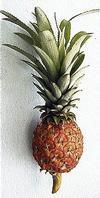
An organic pineapple grown by Dr. Lloyd Gordon in his backyard.
The Ministry of Agriculture and Lands, through the National Organic Agriculture Enhancement Project (NOAEP) is urging farmers practising organic farming, as well as, interested persons to become certified.
Dr. Joseph Lindsay, principal research director of the Bodles Research Station in Old Harbour, St. Catherine, is encouraging farmers to become certified for reasons of international trade. He pointed out that the organic label was an assurance given to the consumer that the product met organic standards. "In the world, market organic goods are given premium prices, they command five times to 20 times more (than) the price given to the non-organic products," he noted.
Help meeting criteria
Currently, the NOAEP is processing 40 applications from persons who wish to be certified.
The NOAEP conducts regular surveys and helps farmers meet the organic criteria. Under the project, a training workshop for farmers is now under way and will be completed in December 2006.
The NOAEP and the Jamaica Organic Agriculture Movement (JOAM) are the local accreditation organisations, along with foreign organisations from the European Union and the United States, which issue certificates to farmers engaged in organic agriculture.
Legitimisation of product
"Organic certification means that you are given a mark and a certificate stating that your product or service has been done according to guidelines and standards set for organic farming by a world market," Dr. Lindsay explained.
"Organic farming demands integrity, it is technical and it is not the every-day subsistence farming," he explained further. He added that labels with organic certification must state that the product or farm was audited and met the requirements.
He pointed out that six local farms have been certified 'organic' by a German company, which means that the farms can now export products to Germany and the United States.
Supermarkets in Germany stock nearly 30,000 organic products, and in 2004, some €3.5 billion were spent on organic foods in that country.