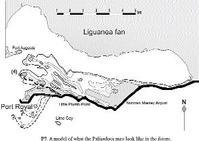
Most of the public concern about the integrity of the Norman Manley Airport and its access road has had to do with two developments that will occur over the next hundred years and more.
Firstly are fears of the effects of future storms like Ivan blocking or even cutting the road and thus preventing access. Secondly, of equal concern, is the prospect of flooding and submergence following current reports in the media about the prospect of rising sea level. Here we add our own penny's worth of predictions for the near future.
Because of global warming, well-documented for the past hundred years, many of the smaller glaciers and parts of the larger ice caps are melting at an accelerating rate. The melt-water from the ice caps plus the thermal expansion of the sea-water itself, due to warming, is generating the rise in sea level. The rate of rise is accelerating.
The envelope of predictions of sea level rise, from many scientists, range from a low of about 10 centimetres to a high of about 85 centimetres over the next hundred years. Recent studies of the Arctic region, as well as the discovery that the Greenland ice sheet is melting at nearly three times the rate of a few years ago, suggest that the high estimate is quite likely. The Intergovernmental Panel on Climate Change published these findings in 2001. The Panel is scheduled to publish revised figures this year. Other scientists have suggested that a sea level rise of as much as 4 metres over the next three to four hundred years is also a strong possibility.
The active beaches along the south side of Palisadoes will probably cope with rising sea level because they are being supplied with new sediment from the rivers to the east. However, excessive sand and gravel extraction from the river beds could rob the beaches of part of their source of sediment so there is the possibility that such supplies will not be available in sufficient quantities to maintain the integrity of the Palisadoes in the future. Well-designed protective measures, applied to the Palisadoes on the ocean side, will certainly diminish or even prevent overwash events and erosion from hurricanes, with the accompanying deposition of junk on the airport highway, although they probably would not be able to cope with a significant tsunami event. Such protective measures are already at an advanced stage of planning at government level.
The same cannot be said for man-made structures, such as the highway surface itself. No amount of protection of the shoreline will stop flooding of the highway by rising sea level, or even temporarily by storm surge. It is important to distinguish between washover events and erosion, induced by large vigorous STORM WAVES, when protection is possible, and flooding, caused by STORM SURGE, and, more gradually, by SEA LEVEL RISE when protection is not possible. In New Orleans last year, the storm surge that overtopped the levees was thought to be 25 feet (seven and a half metres) above normal sea level. Such a surge would temporarily flood both the highway and the airport runway and one cannot build protective levees for open-ended roads and runways.
The surface of the Palisadoes road in some places is already at sea level during times of spring tides. With future sea level rise, flooding will become more frequent. A rise of ten centimetres in twenty years may not seem much, but it will leave the existing road permanently flooded in some places. Without raising the present level of the road surface, the frequency of flooding of the road to the airport cannot but increase. The same argument applies to man-made structures on the harbour side of Palisadoes. Here, structures such as the airport runway and approach road will eventually be submerged unless they are raised. The main runway is high enough that it will not be affected in the near future, except by storm surge, but the approach road is lower and is already subject to flooding. Of course, the remedy is to raise these structures. The engineering solutions are available and, presumably, will be implemented as and when necessary.