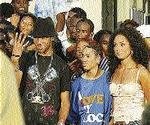
Photo by Kareem LaTouche
Baby Cham and Alicia Keys doing a special shoot with their supporters on the set of the video for 'Ghetto Story: Remix Part Two'.
Krista Henry, Staff Reporter
"Well, I hear dat we not gettin' through to black people. Well, me tell de R and B guy now, he must play dis record because I wan' get to de people."
- Bob Marley
From this dot on the map we call Jamaica, huge voices cross the Caribbean sea and reach the ears of millions worldwide, as Bob Marley, Sean Paul, Shaggy and more have 'crossed over' the physical, cultural and racial barriers that separate nations.
Jon Baker, producer and founder of GeeJam Records, says, "Bob Marley has been in the catalogue pop charts longer than any other artiste, other than Elvis Presley, I think. Bob Marley, the way that Blackwell and Island promoted him, was like a rock act when he was alive. His music is crossover; there's no question about it".
The legacy Marley has left has sparked much debate on who has crossed over and who will be next. There have been countless Jamaican artistes who burn brightly for a second before being doused with the cold harshness of the music business. And is crossing over worthy of the hype? Real success in the music business seems to be announced by attracting listeners who don't know or care to know about the genre's rich history.
The website www.com Wikipedia.com defines 'crossing over' as "the adaptation of a musical style, blending elements of two or more styles or categories, to appeal to a wider audience ... Crossover is highly prized by executives of the music industry, since the profits of a recording that achieves crossover status can be high".
Jon Baker says, "Sean Paul is a natural crossover act, if you listen to his tunes right back to the dutty crew and everything. Cham, his track was helped by Alicia Keyes, but it was also helped from a number of other artistes that guessed on different remixes. That track was a potential track. When you make an album that has mass appeal and all those artistes, perhaps with the exception of Wayne Wonder, certainly Junior Gong, Cham, Sean Paul, it's only natural that a song will come to the fore that has crossover potential and if there is going to be play on a radio format that will introduce your songs to bigger crowds on a larger market then it's a valid thing to do".
Another view
However, not all are enthused about the crop of stars in the Jamaican arena. In an article published in the New York Times under the headline 'Cham: A Clean-Cut Ambassador for Reggae', Kelefa Sanneh writes: "Cham knows better than anyone, he's merely the latest in a long line of reggae stars trying to figure out how to convert momentum and a major-label budget into a viable career. Sean Paul has done it, partly because he never really seemed like part of Jamaica's rough-and-tumble reggae scene. But others, from Damian Marley (last year's great reggae hope) to Elephant Man (who was, briefly, an unlikely hip-hop star) to the respected veteran Beenie Man (whose new album is due later this month), have had a harder time negotiating the American pop charts. It's not entirely the audience's fault either. If there's one thing more fickle than the American record-buying public, it's the Jamaican reggae scene. And the story of reggae in the last few years has largely been a story of false starts, minor triumphs."
In crossing over, Jamaican music influences other genres. "A lot more artistes are using dancehall beats," Harding says. "You'll see Shakeira, Christina Milan, R Kelly; it affects the American artistes. They try to use dancehall beats in their productions. Also programmers abroad get used to dancehall riddims. Back in the day for a dancehall hit to play they had to be crossed over or remixed with hip-hop beats, such as Shabba and Cobra songs. There was the thinking that radio wouldn't play straight dancehall because it sounds weird.
Understanding the music
Now that more American artistes use our beats, radio programmers ears are open to it. They might not understand the lyrics, but they know the beats. We don't have to change our thing to make dance records and other records 'cause they use to it now. There's a better chance of getting records played," he says.
"No one has the magic formula, to say this will cross over or not. We can access songs and seh 'yeah this song is reasonable'. We never thought Sean would be so huge," Harding said.
Baker says, "crossing over is a vehicle of getting your artiste and your artiste's album exposure, but that is one route of many routes to go and it's a very expensive route. The only people playing that route is the major record companies. The Internet and independent way of promoting records will be able to sustain artistes' living, artistes having more control of their music. Crossing over is not going to be there forever and its not going to be as important as it was and becoming less now ... The money that the major record company has to spend for a potential cross over record onto radio is obscene. Therefore, the record industry is changing now; the independence is coming back in. Through marketing and Internet artistes are getting their music out in different ways."
Watering down the lyrics
And does getting your record 'out there' mean that you have to change? Cham, quoted in 'Cham: A Clean-Cut Ambassador for Reggae' says, "you have to find some way without watering down the lyrics, to break the language barrier." Harding agrees. "We don't change it too much. We don't sit down and say Sean we're consciously going to do this and that. He makes his records like he's making them for a Jamaican crowd. He's not as hardcore as other DJs. Some of them make songs too local, so the chance of crossing over is going to be less. Outside people are not going to get all the cultural references and slangs. Its difficult for non-Jamaicans to grasp the meanings. Sean talks about things that all persons can relate to. Look at Temperature," he said.
"Certain aspects of culture you have to get people to accept slowly. Your're asking a lot for them to follow. It's difficult to expect them to understand a new beat, way of life, new words, accept this as English. It took Jamaica a long time to understand hip hop and accept it, learn the slangs. I would like for there to be a more consistent effort. It's not enough right now; there needs to be a ground-breaking. We need for when a Sean Paul video is on, you switch to another station and there's a Beenie video or a Cham video, so all you see are Jamaican acts, to reach a lot more people," Harding said.