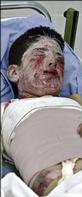
Lebanese Mahmud Srur, eight, from the village of Mansuri lies injured with severe burns at Najm private hospital in south Lebanon's town of Tyre yesterday. Mahmud was injured in an Israeli Apache helicopter missile attack when his family tried to enter Tyre to be evacuated by German and French joint boat missions today. - REUTERS
BEIRUT (Reuters):
ISRAELI WARPLANES pounded Lebanon and Hezbollah rockets crashed into Haifa yesterday as a senior United Nations official demanded a halt to the violence to allow aid to reach desperate civilians.
Civilians have taken the brunt of the 12-day-old war that has taken 369 lives in Lebanon and killed 37 Israelis.
"We have been living in hell," Lebanese farmer Mohammad Zabad, 45, told Reuters in the southern port of Tyre.
Israeli factory worker Keren Hagigi said he had witnessed horrific scenes after a rocket hit an industrial zone in Haifa. "There were wounded people on the road and a wounded person in the building too. There was terrible destruction," he said.
AIR RAIDS
Israeli air raids hit Beirut and east and south Lebanon, killing nine civilians and wounding 100, many of them in Tyre.
Two people were killed and
20 wounded when Hezbollah rockets hit houses and vehicles in Haifa, Israel's third largest city. About 50 people were wounded in similar attacks in at least 10 other towns across northern Israel.
United States (U.S.) Secretary of State Condoleezza Rice, leaving for the Middle East later in the day, has said she will pursue a lasting solution, not an immediate ceasefire. Washington blames Hezbollah and its allies, Syria and Iran, for the conflict.
Syrian Deputy Foreign Minis-ter Fayssal Mekdad said his country was ready for dialogue with the U.S. and wanted an immediate ceasefire, followed by diplomacy to end the war.
Israeli Defence Minister Amir Peretz said Israel could accept a new international force in the south to keep Hezbollah guerrillas at bay and suggested that NATO could lead it.
The U.S. said it would take the idea seriously, but was not considering contributing troops to such a force itself.
"We have been looking carefully at a multinational force perhaps authorised by the (United Nation) Security Council, but not a U.N.-helmeted force," John Bolton, the U.S. Ambassador to the United Nations, told CNN.
HEZBOLLAH CONSENT
It would be very hard to deploy any such force in the mainly Shi'ite Muslim south without the consent of Hezbollah, which touched off the conflict by capturing two Israeli soldiers and killing eight others in a cross-border raid on July 12.
U.N. peacekeepers have pat-rolled the south since Israel first invaded Lebanon in 1978, but their mission to help restore Lebanese Government authority in the area remains unfulfilled.
U.N. emergency relief coordinator Jan Egeland said the violence must stop to enable major aid efforts to get under way.
"The rockets going into Israel have to stop," he said. "The enormous bombardment that we have seen here with one block after another being levelled has to stop," he said as he toured Beirut's shattered Haret Hreik area, a Hezbollah stronghold.
He said Israel had agreed to let aid shipments through its naval blockade of Beirut, but had yet to guarantee safe passage for convoys to distribute aid to up to one million people, some of them in the hardest hit areas in the south.
Black smoke rose from Beirut's Shi'ite suburbs that Israeli warplanes have bombed every day since the conflict began.
Air strikes destroyed a Shi'ite religious centre in the southern city of Sidon, wounding four people. Two people died in a raid on a southern village. Israeli planes also targeted a communications mast near the southern town of Jezzine.
A Lebanese photographer, Layal Najib, was killed near the southern village of Qana during an Israeli bombardment. She was the first fatality among journalists covering the war.
U.N. MILITARY OBSERVER
An Italian unarmed U.N. military observer was wounded during clashes in Maroun al-Ras, a day after the Israeli army captured the southern border village from Hezbollah guerrillas.
The war in Lebanon has displaced half a million people. Others are trapped by fighting, especially in border villages.
More than 1,000 Hezbollah rockets have killed 17 Israeli civilians, prompting between a third to a half of all residents in northern Israel to escape the bombardment, officials said. Twenty Israeli soldiers have also been killed.
Israel has called up thousands of reserve soldiers and has assembled troops and tanks on its northern border, but the army said its chief, Lieutenant-General Dan Halutz, had not decided whether to launch a major ground incursion.


















