- CONTRIBUTED
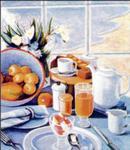
'Window with Still Life' by Devon W. Harvey.
RICH IN its visual art, Jamaica is well placed to realise the economic gains of a most valuable asset.
Naturally, committed artists need to produce creative and diverse art work and themselves must pay more attention to current marketing trends, but for Jamaica to make significant progress in marketing visual art, the innovative strategies of 'brand Jamaica' promoted through tourism, are necessary to energise the artists and the marketing of Jamaica's visual art.
Currently, some local art is available to tourists in hotels but local art is not the principal part of art sales there. Maximising the gains in marketing art will require vision, strategic thinking and imaginative policies which protect the interests of visual artists and their work as with any other 'brand Jamaica' sector.
FOREIGN ART
Attention was drawn to the subject of marketing art in the hotels in an article published on June 28, 2006 in Hospitality Jamaica. It reported that the Honourable Aloun N'Dombet Assamba, Minister of Tourism, Entertainment and Culture, had suggested at a Jamaica Hotel and Tourist Association meeting in Montego Bay, that local artwork was competing adversely with foreign art in the hotels, because she had observed that most artwork in the hotels was foreign.
The chairman of the Negril Chamber of Commerce agreed, but thought that artists needed to organise and make their artwork available to the sector.
On the other hand, however, some hotels do have local artwork in gift shops and use Jamaican art to decorate their rooms, as was pointed out by Sandal's public relations manager at the same event.
EXPOSURE
But the reality is that the potential for exposure of the tourist to Jamaican culture and art products is far greater than is being facilitated by the sector. Cecil Cooper, painter and head of the Art Education Department at the Edna Manley College of the Visual and Performing Arts, was reported in the same article as saying that the Ministry of Tourism should ensure that hoteliers did not sell imported art and should not allow hotels to bring art from abroad.
He added that tourism was a Jamaican product developed by our cultural agents but that nobody was approaching the artists. He noted moreover, that there was no form of funding for development of artists and suggested that the minister needed to meet artists so that together they could make decisions beneficial to both the hotel sector and the artist.
In response to the article, the Jamaica Guild of Artists (JGOA), an organisation of artists, wishes to indicate its willingness to meet the minister for these discussions.
Actively engaging the tourist market, it is anxious to share the experiences of its very proactive efforts in approaching some hotels. Some hoteliers are prepared to explore the Jamaican art business opportunities, but generally, the JGOA has found that art business in local hotels is largely unprotected and unprofitable for the artist.
ARRANGEMENTS
In most cases, foreign art sold in art auctions in the hotels does not include original artwork, but most hotels want local artists to sell their originals and reproductions through the art auction on the same terms. Arrangements discussed are such that when proceeds are calculated, the ratio of proceeds for the hotel and its agents, to that for the artist, can be 80 to 20 or less. When for example a reproduction/print is sold for US$200 in a hotel auction, the hotel gets $60, the auctioneer $60; there is a staff finder fee. The artist's cost will include the frame - $30 - and the reproduction of the artwork may be $20. The artist and the guild will get the balance $30. In most cases, the foreign art auctioneer is the representative of foreign art business and is able to pay a royalty or licence fee to the artist and as the agent, can print copies. In addition, the foreign art sold, enters duty free as it is expected to leave the island. Local artists, on the other hand, pay high prices for art supplies which attract about 45 per cent duty. On return from overseas, artists also pay duty on their own artwork when it re-enters the island, unless it is pre-declared.
Reproduction of paintings is big business internationally and quality prints can be supplied here by local printers, but profit must also be made by the artist. This can happen if the hotel industry works directly with the artist and is best done through the group that represents them the JGOA. Doing business this way will reduce prices to tourists and the high mark-up caused by third parties such as foreign auctioneers. Surely, mutually beneficial business practices used for supplying goods and services to hotels can be replicated so that local art suppliers will also benefit from tourism.
Maximising 'Jamaican Brand' requires that more benefits accrue to Jamaican artists, while offering the tourist easier access to Jamaican culture and a more exciting Jamaican experience.
Cecil Cooper's appeal for government action was endorsed recently by Christopher Gonzales, sculptor, in an interview with Dr. Jonathan Greenland, executive director of the National Gallery and reported in The Sunday Gleaner, July 9, 2006. The JGOA also endorses this appeal. Among points for discussion between the artists and government are policies that will promote art in hotels and the tourist sector in general, protection through strengthening copy right laws, reduction of high import duties charged on art supplies, tax concessions for art sales and government funding for development. The profitability of the Jamaican economy is best served by a collaborative effort.
Contributed by the Jamaica Guild of Artists, jamaicaguild@yahoo.com