- REUTERS
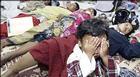
Young child, Fitriani, covers her eyes while waiting for her mother at the Sarjito hospital in the Indonesian city of Yogyakarta yesterday. A powerful earthquake that shook Indonesia's royal city of Yogyakarta killed nearly 3,500 people as houses and government buildings
collapsed near ancient heritage sites in the area.YOGYAKARTA, Indonesia (AP):
A POWERFUL earthquake flattened homes and buildings in central Indonesia early yesterday as people slept, killing more than 3,500 and injuring thousands more in the nation's worst disaster since the 2004 tsunami.
The magnitude-6.2 quake struck at 5:54 a.m. near the royal city of Yogyakarta, 250 miles east of the capital, Jakarta. It was centred about 10 kilometres (six miles) below the surface, the U.S. Geological Survey said.
Activity picked up at nearby Mount Merapi, one of the world's most active volcanoes, warned one geologist, could still spark a large eruption, though another downplayed those concerns.
The quake in the heart of densely-populated Java Island knocked down scores of houses, a hospital and government buildings, sending hysterical people running into the streets. Many roads and bridges were destroyed, hindering efforts to get taxis and pickup trucks filled with wounded to packed hospitals.
MASS GRAVES
In the hardest-hit district of Bantul, rescuers tried to pull bodies from the rubble as residents started digging mass graves, rows of corpses awaiting burial beneath the blazing sun.
Subarjo, a 70-year-old food vendor, sobbed next to his dead wife.
"I couldn't help her," he said. "I was trying to rescue my children ... and then the house collapsed."
President Susilo Bambang Yudhoyono ordered the army to help evacuate victims and arrived in the province yesterday afternoon with a team of Cabinet ministers to oversee rescue operations. He also told people not to fear a tsunami.
At least 3,505 were killed, rescue officials said, adding that more than two thirds of the fatalities occurred in devastated Bantul.
"The numbers just keep rising," said Arifin Muhadi of the Indonesian Red Cross, adding that more than 3,400 people were hurt.
AFTERSHOCK FEARS
As night fell across the affected area, tens of thousands of people were preparing to sleep outside their homes, fearful of aftershocks. Power was out across much of the region, adding to their terror.
In the chaos that followed the quake, civilians carried bloodied survivors, including children, into hospitals, sometimes jumping off flatbed trucks used in construction. Large cracks criss-crossed some roads, while others had collapsed.
Doctors struggled to care for the injured, hundreds of whom were lying on plastic sheets, straw mats and even newspapers outside the overcrowded hospitals, some hooked to intravenous drips dangling from trees.
Bloodstains littered the floor at Yogyakarta's Dr. Sardjito Hospital, along with piles of soiled bandages and used medical supplies. Relatives read verses of the Koran to the injured.