LETTER TO JAMAICA - Focus on collection of existing tax liabilities, says former BoJ head
published:
Monday | April 24, 2006
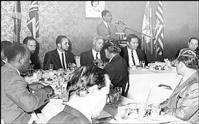
1969: INSURANCE TALK: Mr. Horace Barber, deputy financial secretary, speaking at the monthly luncheon meeting of the Corporation of Insurance Brokers at the Courtleight Manor Hotel in Kingston.
Dear Jamaica,
YOU ENTERED the second half of the first decade of the 21st century with some pleasing positive features. Economic growth averaged 1.2 per cent per annum, cautioned by a per capita real GDP rate lower, on average, than in the nineties; inflation has settled in low double digits; interest rates are at levels more appropriate to production; the manufacturing - construction/installation - and distributive sectors seem to be in a recovery stage; and the unemployment rate has declined.
This suggests adjustment to the consequences of the extreme policy decisions of the 90s: a 'cold turkey' exchange rate mechanism with associated high double digit inflation, a very tight monetary policy aimed at correcting the inflation consequence, and the financial sector 'fall out' from applied monetary/interest rate action.
It appears that monetary and fiscal policy adopted, with some measure of success, a neutral stance during 2001-2004. Unless unexpected factors arise e.g. inappropriate inflation movements, such an approach should continue as sustained growth does require a shift of resources to productive sector activity and the creation of jobs.
SECTOR PERFORMANCE
My forecast of sector performance for 2005 and projections for the period 2006/07, suggest GDP growth averaging 2.2 per cent per annum, compared to 1.2 per cent per annum for the previous five years.
This brings the pace of real per capita growth in line with the average rate for the nineties. The table above presents the picture:
THE BUDGET
Budget neutrality and consolidation, which was the theme for financial year 2005 but not fully achieved, should continue through financial year 2006 and 2007. This implies living within current resources, including 'draw downs'from outstanding liabilities.
Incremental borrowing for current consumption and even asset creation, would worsen the existing situation of an interest 'drag' on the economy (external interest at around 4.5 per cent of GDP) and allocable budget resources.
Also, it would divert domestic financial resources from productive sector activities.
Tax flows are a function of economic activity, account for 85 per cent of current resources, and display a regressive characteristic as over 50 per cent is indirect and consumption based.
While there is some room for tax adjustment/reform, this should not be a priority in the short term. Instead, the focus should be on the collection of existing tax liabilities and correcting, as necessary, the negative impact of external factors such as oil prices. Certainly, additional taxation should not be a choice.
Expenditure policy must be the main weapon in a budget neutrality and consolidation exercise - especially as it relates to current programmes.
However, the options seem limited as interest servicing is 43 per cent of resources while programmes (current/capital) are 57 per cent.
Nevertheless, expenditure priorities should be re-evaluated, programme cost effectiveness measured, programmes closed out as necessary, and the existing structure of government overhauled.
In addition, a growing economy requires infrastructure support (schools, hospitals, roads, water, etc.) which only a government can provide and borrowing should not be the main financial source.
Some equity in the form of public sector saving is negative and has been so for many fiscal years. The suggested period of budget neutrality and consolidation, associated with the appropriate yet difficult decisions, should provide the space to develop appropriate public sector saving flows.
Finally, it is important that the Government recognises the critical role of fiscal affairs and the budget, in the effort to achieve sustained growth and optimum employment opportunities for the work force. I look forward to the forthcoming budget presentation.
With best wishes,
HORACE BARBER
GDP forecast 2005 and projection 2006/7 $Jm
| 2004 | 2005 | | 2006 | 2007 |
| Agriculture/For/Fsh | 13,167 | 12,772 | | 13,538 | 14,241 |
| Mining and quarrying | 13,687 | 14,029 | | 14,310 | 14,596 |
| Manufacturing | 32,715 | 33,205 | | 33,537 | 33,872 |
| Construction and Ins. | 23,343 | 24,160 | | 24,643 | 24,890 |
| Electricity and water | 9,454 | 9,927 | | 10,224 | 10,532 |
| Distribution | 51,923 | 52,183 | | 54,791 | 57,531 |
| Trans/sto./com. | 32,973 | 33,962 | | 34,641 | 34,988 |
| Financial services | 19,640 | 19,786 | | 19,983 | 20,183 |
| Real estate. etc. | 12,193 | 12,376 | | 12,499 | 12,624 |
| Govt. Services | 23,493 | 23,493 | | 23,493 | 23,493 |
| Hotels and mis. services | 21,050 | 21,681 | | 22,356 | 23,003 |
| TOTAL | | 253,589 | | 257,574 | | 264,015 | 269,952 |
| Less imputed serv. charge | 15,794 | 16,134 | | 16,295 | 16,458 |
| Real GDP | | 237,615 | | 241,440 | | 247,720 | 253,484 |
| Growth rate (%) | | | 1.2 | | | 1.6 | | 2.6 | 2.3 |
| Nominal GDP | 475,350 | 482,880 | 495,440 | 506,568 |
Send your comments to editor@gleanerjm.com