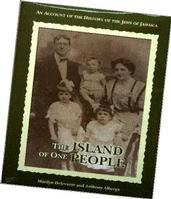
The island of one people
Authors: Marilyn Delevante and Anthony Alberga
Publisher: Ian Randle Reviewer: Barbara Nelson
THE CHURCH of England on Wednesday February 8, apologised for profiting from the 'de-humanising and shameful' slave trade, two centuries after its members helped bring about its abolition in Britain.
In Chapter 8 of The Island of One People An Account of the History of the Jews in Jamaica we read that the Jews in Jamaica did not have "any substantial involvement in the slave trade" although, like many other groups, there was participation in keeping with what was considered to be an acceptable economic activity at that time."
But the authors write "No one can be proud or complacent about this shameful aspect of our history."
L-O-N-G STORY
The history of the Jews in Jamaica is a l-o-n-g story! But it is a fascinating one "of struggle, adaptation, change, accommodation, assimilation and sometimes another migration." It's a story of people who made Jamaica their home, who have made significant contributions to the development of the nation, but whose numbers are today in serious decline. In 2005 the Jewish community in Jamaica celebrated 350 year of freedom to practice its religion.
Anthony Johnson in his book Kingston-Portrait of a City
says, 'They (the Jews) have been residents of Jamaica during the Spanish period and therefore have the longest record of any segment of the current Jamaican population."
Why did the Jews come to Jamaica? Where did they come from? How did they react to the conquest of Jamaica? Why did Sephardic Jews come from the Middle East in the early twentieth century? Did Ashkenazi Jews fleeing Nazi Germany come to Jamaica?
All these questions and many more are answered in The Island of One People An Account of the History of the Jews in Jamaica, a well-written, well-researched volume that is compassionately written, absorbing and easy to read.
The invasion of Jamaica by the English in 1655 was pivotal for the Jews as they no longer had to
hide their faith and were allowed freedom of religious practice which did not happen under the Spaniards. The Jews, in fact, have come to be accepted as the first permanent European settlers in the island.
The story unfolds throughout 29 chapters. It tells how the Jews in Jamaica built their first synagogue in Port Royal in 1677 and brought rabbis from overseas; how they became engaged in a flourishing trade with Central and South America; how they represented 5 per cent of the white population and were treated as second- class citizens; how they were expected to pay 17 per cent of the entire taxation burden, but were not allowed to vote.
At the turn of the eighteenth century the Jewish community in Jamaica undertook a struggle for their civil rights that was to last until 1831.
In July 1831 the act that would allow Jews to be elected members of the Corporation to govern the City of Kingston was confirmed in Council. It was passed in 1830. Moses Delgado (1789 1842) played a key role in the fight for Jewish Civil liberties in Jamaica.
This removal of all
disabilities from the Jews was a significant victory for human rights in Jamaica and worked to the benefit of Jews in the United Kingdom and in Canada. They cited the situation in Jamaica to justify their own claims. Jews began to take their places in various public positions in Jamaica and this continued into the twentieth century.
The Jewish community has contributed in diverse ways to the prosperity and development of the city of Kingston. From the early eighteenth century the Jews dominated commercial life in the city. They were also prominent in business, public and civic life in Montego Bay for some time. "Today," however, "there are only a handful of Jews in Montego Bay."
The Island of One People examines several aspects of Jewish life in Jamaica ranging from 'The Merchants of Kingston', to 'The Jewish Connection to Free-masonry', their contribution to
'Art and Culture' and 'A Family
of Rabbis'.
IN-DEPTH LOOK
In later chapters the authors take an in-depth look at several Jewish families and the part each family played in the growth and development of the nation.
This is a really fascinating part of the book. We read about the J. Wray and Nephew connection; the deCordovas and The Gleaner, the artist Isaac Mendes Belisario, Fred. L Myers and Son; the Jamaican Jews and their involvement in the construction of the Panama Canal, the Matalon family, the Alberga family, to name some.
Of the Matalon family Mark Ricketts wrote in the editorial of the Money Index in June 1992 "There is probably no other
family that has shaped or at least influenced Jamaica's post war development as the Matalons.
Yes, it's a long story but a
beautifully written one. It is "a
celebration and a remembering" definitely a must-read for anyone who wants a clearer picture and deeper understanding of the history of the Jamaican people and the significant part played by the Jews in making us who we are.


















