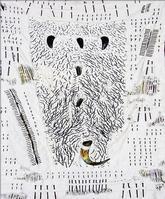
The Vicissitudes of Memory.
K. Khalfani Ra is a Jamaican artist living and working in Kingston. His work is showing in Curator's Eye II at the National Gallery of Jamaica. Here, he discusses his work with Dr. Jonathan Greenland, executive director of the National Gallery of Jamaica.
Please tell us about your work The Vicissitudes of Memory: Long Live the Maroon Killers, Death to the Maroon Traitors. For De Serras the Unsung.
Everything that can be known about the work is there, both in terms of the work on the wall and the title. The primary thing is the work on the wall but the title can be as important as the work. After that, anything people want to know they can find out for themselves. But intellectual
laziness, particularly where it concerns knowledge about black people, is a hallmark of the Jamaican character scholars ar not immun from this dficit.
The title is extremely powerful.
Annie Paul in her review of the exhibition made some comments about the title and the work itself. Carey Robinson's book 'Fight For Freedom' is a historical account of some detail of the African Juan De Serras and his triumph over the Spanish, the English and his own treacherous brethren led by Juan De Bolas, or 'Lubolo'. Typically Juan De Bolas, like Cudjoe almost a hundred years later, is celebrated institutionally in this country as a folk hero, even though he struck a deal with the English to kill or capture the indomitable De Serras. It is no accident that self-hatred and self-alienation is rampant in the psyche and personality of Jamaican blacks.
Some people have seen the reflection of the image of the old diagrams of slave ships in some of your works, is this true?
No, there is nothing of that. I can't see that at all. All art, in fact, has a life, an interpretation, beyond the artist but I feel the people who see these images of the slave ship are imposing a victim mentality on the work.
Would you describe yourself
as a political artist?
Totally. Everything in life is governed by politics.
What is your strongest
influence?
Africa. Marcus Garvey. What affects me culturally, affects me artistically. Garvey was interested in cultural practice in general.
It is easy to see the influence of African art on your work: you use symbolically powerful materials like horns and nails and the nails remind me of power figures from the Congo.
It was a very early project of mine to create a new aesthetic or a new visual language; one which was more appropriate to my world view. There is a certain amount of purposeful atavism in this. That is, I remake myself in the image of Africa, but not in a limited or sentimental way. It is a lifetime project.
Do you have any
favourite materials?
No. Not really. My next works to be shown may look very different. The materials I use are always subject to the content of the work. And I purposefully don't work on canvas. Even though the label says mixed media on fabric some people still go and write 'canvas'.
Both Leon Wainwright
and Annie Paul in their reviews of your work have referred to the power of the reversed nails and horns,
sticking out at the viewer.
Leon Wainwright spoke to me and mentioned he was interested in the reversal of the nails and the consequent 'impalement' of the viewer. Reversal is a key metaphor for my work in general. In that respect it is an accurate statement. Reversals conceptually, reversals in history, and reversals in politics. Reversal in itself is a weapon. One of the things happening nowadays is that there is a lot of Black revisionist work being done in history. This can be seen as a weapon which Africans can use in their continual march towards self emancipation. As for the horns and nails, the whole work becomes a weapon for offence and defense.
Do you care if people understand your work?
I am not a didactic artist. But art is crucial to nation building. My work can help in that national evolution. Art is not the be-all and end-all of everything, but it is part of our inquiry. People can engage with the work and themselves. The work is a projected self-image.
Eddie Chambers described your works as highly opinionated or highly contentious commentaries on Jamaican history. Are you engaged with Jamaican history?
Yes. Not just Jamaican history but world history. To be engaged with the history of blacks is to be engaged in world history.
Even though your works
are political, they are also beautiful to look at.
I have never heard 'beautiful' used to describe my work. It sounds like a non-sequiter to me. If they are beautiful people would be buying them and they are not! I don't always like them myself. But I know when they are good, for example: the big one in this exhibition, The Zumbi Imperative, I know it is good. But personally, there is something missing in it for me. My purpose is different from beauty.
These works are not intended to be something to be attracted by. The Jamaican art scene caters very much to what is attractive. You say it is attractive, but I don't hear you say you are buying one!
They remind me very much of East African textiles.
The process of making these works is multidimensional. But some things are specifically targeted, for example: people can see Africa in the form of the work.
Do the same things apply to your other work in the exhibition The Zumbi Imperative: Palmares the First Republic, Cucau/New Orleans/Jamaica, The Cursed Lowlands?
Last year was the Tricentenial of the Republic of Palmares in Brazil. Palmares was the first republic in the western hemisphere. It was founded in the mid 1700s, before the United States was declared a republic. Zumbi was its foremost African leader. He is celebrated in Brazil and he is well-known to many people. He is famous because of his refusal to sign any peace treaties with the Portugese or the Dutch. This is the main inspiration for this work.
The Portugese and the Dutch tried and failed many times to defeat the Africans of Palmares and eventually they sued for peace. Their intention was to send them to Cucau. It would be a reservation for them. But when they went there they found they couldn't live there. That is a metaphor for all forms of
conquest. And so Zumbi led a revolution. I leave the rest to the viewer.
You works are real lessons.
A re you a teacher?
Yes. I am. But, as I said before, they are not didactic. While they may campaign, they are not mono-referential and I think it is obvious that the works are not limited by or to their titles.
Who is your favourite artist?
Fela Kuti, the Nigerian
musician, politician and
Pan-Africanist.
* Curator's Eye II, Identity and History: Personal and Social Narratives in Art in Jamaica is curated by Dr. Eddie Chambers. The exhibition runs through March 18 Please call the National Gallery at 922-1561 for
more details or email us at
natgalja@cwjamaica.com.


















