Prince Neto Waite, Contributor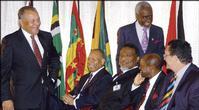
CARICOM prime ministers assemble at the official launch of the CSM at the University of the West Indies, Mona, on Monday, January 30. From left are Owen Authur, Barbados; Patrick Manning, Trinidad and Tobago; Sam Hinds, Guyana; P.J. Patterson (standing), Jamaica; Dr. Denzil Douglas, St. Kitts and Nevis, and Dr. Kenny Anthony, St. Lucia. - RUDOLPH BROWN/CHIEF PHOTOGRAPHER
CARIBBEAN ECONOMIC integration may be in a more precarious state than we realise. This is partly due to the failure of some Caribbean governments to acknowledge advice from various legal and political commentators. Specifically, some analysts have advised that governments should first inaugurate the Caribbean Court of Justice (CCJ) as a trade court until the problems with its functions in its appellate jurisdiction are sorted out.
As a result, the Caribbean and its efforts at regional integration are in a most precarious position, one that may never be sorted out until the CCJ debate is brought to a resolution.
While I support the overarching intention and objective of both the CCJ and the Caribbean Single Market and Economy (CSME), it is my view that some of these concerns must be taken on board so as not to jeopardise their chances of success.
This assertion is with reference to the Revised Treaty of Chaguaramas, the supreme document of the CSME regime. Article 211 of the treaty states that, "The court shall have compulsory and exclusive jurisdiction to hear and determine disputes concerning the interpretation and application of the treaty." This includes disputes between the member states to the agreement and between member states to the agreement and the community. In other words, no other body or court can give binding and official interpretations of the treaty.
A PRECARIOUS POSITION
Now why does this provision make the efforts at regional integration precarious? A strict interpretation of the above clause would support the view that the CCJ should, and must, be inaugurated before the CSME comes into force.
This is paramount for the effective and sustained functioning of the regime, for the court is vested with the responsibility of interpreting the treaty. This responsibility and duty were conferred upon the court by the treaty itself.
As a result, it appears that countries participating in the CSME do not have refuge in any other court to solve any question arising that may relate to the interpretation of the treaty. The situation then, is that Jamaica, Barbados and Trinidad and Tobago are on the verge of implementing the CSME among themselves while giving other members some time to come on board.
Due to the importance of the CCJ to the CSME apparatus, it is not advisable to contemplate putting the CSME into effect without the basic yet vital institution, the CCJ, for this may create an environment that encourages the breaching of fundamental legal principles and that of governance, thereby undermining regional integration in its entirety.
Moreover, in Jamaica the bills to pave the way for the CCJ, though passed by Parliament, have encountered choppy waters. Meanwhile, in Trinidad and Tobago they have not been tabled as yet because of political wrangling and this situation may continue for some time to come. So, even two of the proposed initial members of the CSME may not for quite some time resolve the CCJ debate.
RESOLVING DISPUTES
The above view is based in principle, logic and the legal analysis, therefore let me make it practical. Jamaica and Trinidad and Tobago are now undertaking discussions with the hope that Trinidad and Tobago may supply Jamaica with natural gas. Now a dispute has already arisen.
The Jamaican Government is of the view that according to the treaty, specifically Article 7, it should be able to purchase the natural gas from Trinidad & Tobago at prices available to consumers in the domestic market of Trinidad and Tobago. Trinidad and Tobago says this is not so. Clearly, the interpretation of the Treaty is in dispute and the CCJ is needed.
However, there will be no court or body to interpret the treaty should Jamaica, Barbados and Trinidad and Tobago go ahead and start the CSME at this time.
Thankfully, the Patterson and Manning governments have been able to resolve the dispute through a bilateral agreement. Though commendable, this is not a recommended way to resolve all disputes, for undoubtedly there will be situations in which bilateral agreements are just not enough to resolve the matter. In addition, such a practice undermines the institutions that are being set up to support and maintain regional integration.
It may be thought that among the disputants they could agree to use a particular jurisdiction, say a third-party national court, to solve the dispute. But this is not practicable on two grounds. First, this move will be against the same treaty which the disputants are trying to have interpreted; and secondly, the court will as a matter of course dismiss the case on the ground that it does not have the power to interpret the treaty for the CCJ has the compulsory and exclusive jurisdiction in the interpretation and application of the treaty. The two institutions are interlinked and one needs to be inaugurated before the other for the process to be sustainable and effective.
SEPARATION OF POWERS
The principle of the separation of powers is very important to governance at any level be it domestic, regional or international. Additionally, the judiciary (the courts) is jealously guarded by any enabling document. Though not in its classic form, the apparatus of government still exists within the CSME framework. The CCJ is integral to the completion of this framework and its effectiveness.
Now should these three enthusiastic Caribbean governments get the CSME off the ground at this time they would be undermining the fundamental principle of separation of powers. A result of this is that the citizens of Barbados, Jamaica and Trinidad and Tobago will be operating in the incomplete regulatory framework of the CSME.
Moreover, they will be rolling back the tides and principles of modern governance and unnecessarily testing to the extreme the importance of the judiciary to modern democratic systems.
In solving this present dilemma, whichever approach is taken, political will is needed from both government and non-governmental groups. Simply put, they both need to amend the treaty and split the jurisdiction of the court and implement it on a phased basis, first, the trade court and secondly, the appeal court.
Alternatively, educate the people of the region and allow them to make the decision. If neither approach is taken to sort this matter out in a timely fashion, regional integration in whatever shape or form will be unnecessarily protracted and weakened.
Prince Neto Waite is a
student in the Faculty of Law, University of the West Indies, Mona.