Don Anderson, Contributor 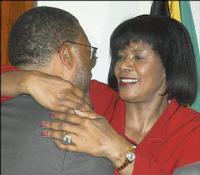
Portia Simpson Miller, Minister of Local Government, Community Development and Sports and Prime Minister-designate, embraces Dr. Peter Phillips, Minister of National Security, during the weekly Cabinet meeting held at Jamaica House on February 27. - JIS PHOTO
THE PEOPLE'S National Party (PNP) presidential elections of February 25 represented the culmination of positive trends for the
winner, now president-elect and Prime Minister-designate, Portia Simpson Miller.
Over the last two years, from February 2004, the Gleaner/Don Anderson polls have been tracking who the general public feels is the best person within the PNP ranks to take over from P.J. Patterson when he demits office.
Patterson had indicated soon after the 2002 election that he would not lead the PNP into another national election and late last year gave clear notice that he would do so in 2006.
The Gleaner/Don Anderson team has been tracking public opinion on the issue since 2004. On each of these surveys, a minimum of 1,000 persons were interviewed, using a nationally representative sample of persons 18 years and over.
In February 2004, over 33 per cent of all persons interviewed rated Simpson Miller the best performing minister, well ahead of any others and significantly more than the eight per cent so rating Phillips. All polls done since 1999 have, in fact, installed Simpson Miller as the best performing minister.
LOGICAL SUCCESSOR
TO P.J. PATTERSON
In the same February 2004 poll, 44 per cent regarded Simpson Miller as the person they saw as the logical successor to Patterson and the best person to succeed him. Support for Simpson Miller came primarily from young persons in, the 18-24 age group. In that poll, 30 per cent believed that Phillips was the best person to succeed P.J. Patterson. That poll, indeed, represents the closest the public has rated the two ministers as likely successors to Patterson and the highest percentage opting for Phillips in all the polls.
By July 2004, the gap between the two had widened significantly, with over 52 per cent feeling that Simpson Miller was the best person to succeed Patterson, compared to 21.8 per cent viewing Phillips as this person. In that poll, Simpson Miller's support came primarily from females and from low-income persons. Omar Davies and Karl Blythe between them accounted for 10 per cent of the popular support on this issue.
BEST PERSON TO
SUCCEED P.J. PATTERSON
The February 2005 poll confirmed the positions established in the July 2004 poll, with close to 54 per cent identifying Simpson Miller as the best person to succeed P.J Patterson, an increase of some two per cent over her 2004 performance. Simpson Miller's principal support again came from females within the population, as well as persons 18-24 years old.
By contrast, Phillips' support for the presidency fell by one per cent to just over 20 per cent. This poll also represented the first time and only time that Karl Blythe was better rated than Omar Davies, but their combined numbers were less than Phillips'.
The June 2005 poll showed solidification of Simpson Miller's position as the person best to succeed P.J. Patterson, despite the fall-off of some two percentage points from her February 2005 support. Over 51 per cent maintained that Simpson Miller was the best person to succeed P.J. Patterson. Phillips picked up just under two per-centage points, possibly at the expense of Simpson Miller, to achieve a 22 per cent support level. Davies regained the third position at the expense of Blythe, recording a high of 10 per cent, giving rise to the speculation that he was gaining ground and picking up support.
SUPPORT GROWS
FOR SIMPSON MILLER
Two polls were conducted between November 2005 and December 2006 which showed remarkable consistency with the previous polls over the last two years as well as the outcome of the February 2006 elections themselves.
In the November 2005 poll, Simpson Miller's support for taking over the presidency of the PNP grew to 58 per cent against a fall-off to 20 per cent for Peter Phillips. By then the presidential campaign was in full gear and the general public was therefore exposed to the various platforms put forward by the respective candidates. It is significant to note that Simpson Miller's strongest support came from females and persons 18-24.
The December 2005 poll was a privately commissioned poll. The results of that poll further confirmed that Simpson Miller was the clear choice of the people to succeed P.J.Patterson. Close to 62 per cent of all persons interviewed felt that she was the best person to succeed P.J.Patterson, compared to 20 per cent who felt that Phillips was that person. Nearly 11 per cent opted for Davies and seven per cent for Blythe.
The general public did not vote in the elections of February 2006, but there is a remarkable similarity in the outcomes. Simpson Miller won comfortably, followed by Phillips, with Davies a distant third and Blythe further behind. This pecking order reflected the perspectives of the general public in every poll since 2004. It is also surely instructive that throughout the polls from 2004 to the present, Simpson Miller's support was largely from the females and young persons 18-24 years old. Certainly from the delegate vote of February 25, there was significant female support for her.
PORTIA VERSUS BRUCE
From a national perspective, two other issues are worthy of consideration. In both the November 2005 and December 2005 polls, Portia Simpson Miller was clearly installed as the candidate most likely to beat Bruce Golding in a national election. Those numbers were also very clearly indicative of the strong political reputation that Simpson Miller had established among the general public. In the November poll, 59 per cent felt that she was the candidate who stood the best chance of beating a Bruce Golding-led JLP. Just 19 per cent felt that Phillips was the
candidate with the best chance of beating Golding.
When that question was repeated in the privately conducted poll, 62 per cent gave that vote to Simpson Miller, an increase of some three percentage points. Twenty per cent felt that Phillips had the best chance of beating a Bruce Golding- led JLP.