Barbara Ellington, Lifestyle Editor
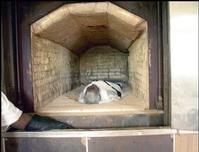
This body is placed on a lifter and hoisted into the concrete interior of the oven. Smoke curls up opening in the roof and out the chimney. The cremation process takes up to four and a half hours.
I HAVE HAD A FASCINATION for the dead since I was in infant school. My fascination began because the district of Smithville in Clarendon, was suddenly awakened from its pre-dawn slumber one early morning by the sounds of loud gunshots. By the time the bleary-eyed crowd of villagers had gathered, two bodies were already lifeless, but still oozing rich, red blood from open wounds. One, was a woman lying in her yard where she had run and collapsed and the other was behind the counter in his shop at the heart of the village close to the house.
The shopkeeper had shot and killed his girlfriend and then himself. But what fascinated my little mind was the scene later that morning as the doctor performed an autopsy on his body in full view of the crowd. Laid out on a piece of board, the deceased's huge belly was cut open and I still recall the layers of thick white fat and all his intestines and organs laid bare for all to see as the doctor probed for the bullet.
I also remember some people covering eyes and noses, others sobbing. My grandmother vainly tried to get me to go back home but I just slipped away between adults' legs only to return when the coast was clear. I stood behind the apple tree, just about very close to the action, eating a piece of sugar cane while I watched the scene, totally absorbed.
From that day on, if anyone drowned in one of the rivers nearby, I had to see the body and in my adult years, when I attend a funeral, it seemed pointless unless I got a good look at the body in the casket. I cannot rid myself of the reality of the moment - here today, hale and hearty, wealthy and wise, rich and powerful, only to be reduced to a cold, hard mass - soul and spirit gone. What remains will either be interred, left unclaimed or these days, cremated. And I don't get nightmares about it either, I know for sure that dead bodies have no power over the living. (Yeah, right). In fact, I'd rather take my chances in any rural cemetery for a solo all-night stay, than walk alone downtown Kingston in broad daylight.
CREMATION
Cremation has become a cheaper way to dispose of human remains and funeral directors like Maddens Funeral Home are equipped to offer this alternative to clients. In the Hindu tradition, elaborate rituals accompany cremation. The body is lit at set points on a wooden pyre and there is an accompanying ceremony. In Jamaica, only members of the Indian community actually attend the cremation of loved ones.
It is rare for family members to attend a cremation, but they could if they wanted to. My childhood fascination with death and dying has only intensified with the passage of years and I have always wanted to witness a cremation just to see the process of literally retuning to the dust from whence we came.
Ironically, I do not want to be cremated; I'm not taking any chances on being cooked alive. So when Mr. Ferdinand Madden said he'd arrange for me to witness one, I embraced the opportunity with almost the same level of excitement that I felt on that morning several years ago in Smithville.
I arrived at the Dovecot Crematorium located close to the entrance of the Dovecot Cemetery in St. Catherine, with enough time to visit my granny's grave and get a little "blessing" to cover me in case any duppy decided to follow me home. No, I'm not superstitions, I'm a Jamaican who's heard stories often enough to respect old folks wisdom.
That done, I got a quick tour of the facility which houses the large oven; a large blender for crushing bones and some reinforced plastic bags of ashes. A chat with William Parks reveals that he has been working at the crematorium since the '70s. He knows the job inside out and he remains unpurturbed by the scores of bodies that have passed through his hands. There is surprisingly nothing ghoulish, morbid or eerie here; I don't get the tell-tale goose bumps that appear when I'm scared and as wait, I watch the gardeners mow the lawns outside while trading stories with Mr. Parkes about the misuse of ashes left in the wrong place at home.
The van bearing the three bodies for cremation arrives and the men remove one infant and two seniors. Again I 'm seized by the reality of what an equaliser death is. At that point, the funeral and tears have gone; no loved one is there no one to bid a last farewell. So I whisper a silent prayer (as if it will make a difference), and stand aside for the men to do their work. They remove the covering from the faces of the adults at my request and I stare more amazed at the seemingly nonchalant manner that they move bodies from vehicle to crematorium waiting area.
HOW IT WORKS
The furnace is lit by George Powell who has been doing his job since 1980. He and the other two men helping to move bodies sport a white lab coats and gloves as they easily approach a task from which most would flinch. The temperature inside the oven reaches 1,500 degrees Fahrenheit at its most intense. The first body will take over four hours to be cremated, but the others will take roughly three and a half hours.
Mr. Powell explained that before each cremation, a doctor the police commissioner's office as well as the ministry of health have to give their approvals then the funeral director is free to pursue.
The lab coated men place the first body onto a lifter which reaches the height of the furnace. Caskets are sometimes used but the bodies cremated on my visit were not enclosed in any container. Once the oven is closed, the flame is soon ignited and I was invited to stand on a stool to peep through a window at what is happening inside. I saw the deceased woman's hands folded in death across the her chest, as the fingers are licked by a beautiful deep orange flame.
"It will take a while," I was told, when I expressed surprise that only her fingers were seared through; there's no odour but the smoke goes out through the chimney above. And at that point I knew for sure that I want to be embalmed and buried in the bowels of the earth.
PULVERISED
The other two bodies will lie there waiting their turn. Duties at the office beckon and much as I would love to see the entire process, I cannot. But when the process in the oven is complete, the huge stainless steel blender in the adjoining room is where the bones left after the fire will be pulverised to the consistency of fine sand or white pepper. The blender is cleaned after each use.
Did you know that after cremation what becomes 'ashes' are the eight or so largest bones in the body? Everything else melts in the fire.
UNCLAIMED ASHES
Close to the blender on a table is a huge pile of unclaimed ashes; the plastic bags are labelled with the names of the deceased and if unclaimed after three years, they are buried at Dovecot. Mr. Powell told Lifestyle that the late psychic Safa who died in June 2002 and was cremated, was only recently buried.


















