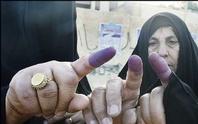
Iraqi women show their ink-stained fingers after voting during Iraq's historic parliamentary elections in the Iraqi city of Najaf, south of Baghdad, yesterday. A steady stream of voters walked to polling stations nationwide yesterday to elect their first full-time Parliament since Saddam Hussein's overthrow, ignoring sporadic violence such as a mortar attack in Baghdad. - REUTERS
BAGHDAD (Reuters):
UNDETERRED BY scattered violence, Iraqis voted in large numbers in an election yesterday, with minority Sunni Arabs who boycotted the last poll determined not to miss out on power again.
The demand to vote was so strong that polling stations were kept open for an extra hour in some areas to allow those lining up outside to cast their ballots.
The largely peaceful election, which will raise United States hopes that a stable government can pave the way for American troops to pull out of Iraq, was in sharp contrast to January's vote for an interim assembly, when 40 people died.
Sunni Arabs mostly boycotted that poll but took part with enthusiasm yesterday, backed by nationalist rebels who vowed to protect those who voted.
DELIGHTED TO VOTE
"I'm delighted to be voting for the first time because this election will lead to the American occupation forces leaving," said Jamal Mahmoud, 21, in the battle-scarred city of Ramadi.
Turnout in 10 hours of voting was at least 10 million, or 67 per cent, Election Commission chief Hussein Hendawi told Reuters, much higher than the 58 per cent seen on January 30.
In Saddam Hussein's home province around Tikrit, once a heartland of Sunni Arab opposition, turnout was 83 per cent, a local electoral official told Reuters.
Definitive tallies could take two weeks or more, officials say.
United Nations envoy Ashraf Qazi was pleased: "All in all it was a good day and a historic day," he told Reuters. A White House spokesman also called it a historic day.
Informal polling by Reuters around the country showed the ruling Shi'ite Islamist Alliance and their Kurdish allies still dominant in their southern and northern bases, respectively.
But there also seemed to be a strong turnout in favour of former Prime Minister Iyad Allawi, who heads a secular slate with candidates from across Iraq's sectarian and ethnic divides.
While voting went well generally, two people were killed in mortar attacks in Mosul and Tal Afar in the north and three, including a U.S. Marine, were wounded when a mortar round landed in Baghdad's Green Zone as polls opened at 7 a.m.
The U.S. military separately announced that a Marine had been killed near Ramadi on Wednesday.
A nationwide three-day traffic ban, and the presence of 200,000 Iraqi soldiers and police backed up by U.S. troops, appeared to succeed in protecting 6,000 polling stations.
The interior minister said a suicide car bomber was shot dead in Baghdad and police said they arrested another east of the capital.
U.S. diplomats hope that if Sunnis are drawn into the political process, the revolt will be undermined, letting Iraqis gradually take over security without provoking a civil war.
"Ballot boxes are a victory of democracy over dictatorship," said Prime Minister Ibrahim al-Jaafari after voting, his finger purple with the dye that prevents double voting and is a symbol of Iraqi democracy. "They've chosen voting over bombs."
SUNNI TURNOUT
In Falluja, west of Baghdad, scene of the biggest battle between U.S. forces and rebels a year ago, a shortage of ballot papers and of vehicles to ferry infirm voters held up voting.
Bitter at the power exercised this year by an interim parliament of Shi'ite Islamists and Kurds, Sunni militants said they would defend polling stations in cities like Ramadi against groups such as al Qaeda who vowed to disrupt the vote.
"Sunni Arabs made a big mistake in boycotting the last election; it left us out of ... writing the constitution," said Talal Ali, 25, as he voted for the first time in Kirkuk.
He backed one of the main Sunni lists which wants to amend a constitution, agreed two months ago, that Sunnis say could hand Kirkuk's oil to independence-minded Kurds and give Shi'ites control over the southern oilfields.
Once a coalition government is formed, which could take weeks, the first task of the new parliament, under U.S. pressure, is to address Sunni grievances over the constitution, passed with Shi'ite and Kurdish votes in a referendum.
While those battles lie ahead, there was hope of a better future among voters on Thursday.
In Baghdad, Shi'ite Hadi Mishaal, wounded in the 1991 Gulf War and forced by the traffic ban to hobble 2 km (over a mile) on a crutch to vote with his wife, said: "I hope we can have a government that will help me and give me my rights."
In Kirkuk, 60-year-old Sunni Arab Asmael Nouri said: "It is the first time I have tasted the freedom to express my view."
For many in the 60-percent Shi'ite majority, oppressed by Saddam, the vote was another chance to seek redress.
Religious voter Kadhmiya Alwan, 55, said in Najaf: "I demand they take my revenge on the regime that killed my two sons."
There were signs secular parties, notably that led by Allawi, were cutting into the 48 percent vote the Islamist bloc took in January.
"We want freedom ... to drink alcohol, dance and go to nightclubs," said Allawi supporter Jasim Faisal, 34, in the southern city of Samawa.
Yet underlying a vote in which Iraqis can choose from 231 lists, is also widespread sectarian fear and mistrust.
Healing the rifts was the campaign theme of Allawi, appointed prime minister last year under U.S. occupation.
Many believe Allawi could lead a coalition government, a development Washington might endorse after losing patience with Jaafari, whose term has seen the rise of violent pro-government militias and warm ties with America's enemies in Shi'ite Iran.
"We hope to see a formation of a strong government that can ... represent the main communities and be a government of national salvation," Allawi said after casting his vote.
There are no reliable opinion polls but observers expect the Shi'ite alliance share of the vote to fall, from 48 percent in January to about 40 percent. Kurds may win about 25 percent, and could be challenged for second place by Allawi.


















