By Avia Ustanny, Outlook Writer 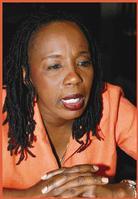
CARMETA ALBARUS-RODNEY, President of CVA Consulting Services, a forensic social work firm based in the Harlem community of New York City and a former Jamaican teacher arrived home recently to speak to guidance counsellors on the subject of adolescent males and their needs.
'Love Our Boys. Empower Them", was the theme of the Johnson and Johnson sponsored symposium held at the Jamaica Conference Centre in downtown Kingston.
Outlook caught up with Rodney who spoke about Lee Boyd Malvo, the Jamaican teen involved in the Washington DC Sniper case and for whom she was the death penalty mitigation consultant.
Investigations
Ms. Rodney is an expert in social history investigations and psychosocial assessments.
"Most of my work is in death penalty litigation," Ms Rodney told Outlook.
The former teacher switched to forensic social work in a bid to have a more sustained impact on the lives of the young in a system which focuses more on punishment than rehabilitation.
"There really is an overrepresentation of Jamaican young men in the criminal justice system (US Federal)."
Rodney, in her own way has decided to do what she can to help. Speaking from her experience in her Harlem-based agency she noted that the pattern of Caribbean parents abandoning their boys to the care of others is one that is having a negative effect on boys especially.
"There are a lot of clients who were left as children - another client who I have, an 18-year-old Jamaican was left at six months. He may have seen his mother twice -- once when he was five and another time when he was 10 but basically he was a stranger to her. There was no bonding."
Young males who are so abandoned usually gravitate to the streets. They are also affected by the absence of the father.
Among her clientele which includes 60 per cent blacks, 35 per cent Hispanic and "very few are whites, for all of them the dominant theme is parental neglect."
Rodney also notes that Caribbean migrant children, especially, "are not socialised or prepared for what they are likely to face when they go to live abroad.
"They only see the lifestyle on television and may have been barrel kids where the barrel replaced their parents. They are into this whole cultural materialism and then go and find out that things are not what they were painted to be."
When they arrive in the United States, boys are subjected to teasing. "One I know was being called 'coconut-head'. They are different and they feel like misfits. Most join up with other misfits. Some of our children unfortunately fall victim to that."
Influenced
Lee Boyd Malvo, she said, was clearly influenced. "You only have to meet the young man to pick up that he was influenced...he was brain-washed. There is not even a hint of his Jamaican identity... just years and years of indoctrination. Only gradually did you see the Jamaican personality emerge. I cannot help but wonder if he had not been so influenced if he would not now have been graduating from sixth form like his best friend here in Jamaica.
Rodney says that she is committed to help such boys who get lost in the system. When boys become men with a prison record, she has also found a way to intervene. Since 2002, Rodney has been sending money out of her own pocket to the Jamaica Red Cross Operation FURI which aims to assist in the resettlement of deportees. She has also been making strenuous efforts to get others to help financially - so far with no success.
The death penalty mitigation expert says that she wishes more Jamaicans would get involved in helping their countrymen. The day she decided to get her US citizenship, she revealed, was on one occasion when the division between rich and poor in the island was revealed starkly to her.
Conducting investigations in Majesty Gardens in Kingston on behalf of someone who was about to be deported, she could not help but note the sincerity and good heartedness of many of his relatives in spite of their dire poverty. Later that same day, the contrast of people shopping in an uptown supermarket which they could never enter was too much for her. She decided to become an American.
Rodney is electrified by injustice and always moves to act, if only in protest. But, more usually, she is able to do something about matters that deeply concern her, hence her work with deportees and the Red Cross.
She has also taken on the cause of abused women who commit crimes as a result of their situation. In this arena, her appeals for sentence mitigation have been 100 per cent successful.
"I have had a number of cases where women saw no escape route and were so psychologically paralysed that they commit a crime."
She speaks on their behalf.
Inspired
Carmeta Rodney, who grew up in Fletchers Land, Kingston, said that she was inspired first, to become a teacher because of a friend of her mother's who told her by word and example that she could be anything she wanted to be.
By age 17 she was a student of St. Josephs Teachers College, leaving that institution qualified to enter the classroom and moving on to teach at Holy Trinity, Norman Gardens and Kingston Technical secondary schools.
Teaching was economically tough and so she started baking ginger bullas. This was a successful venture, as at one point she was making as many as 2,000 bags each day and employed 15 people.
When her husband, a young engineer whom she married right out of college, decided to migrate, she went with him. Opting to baby sit instead of teaching in the new culture, Rodney also spent three years thinking about her next step. She considered law, she said, because she liked to talk. But then she got involved in a case in which she "knew in her heart" that the accused was innocent. Right then, she realised her career would be in social work.
"It's a career in which being black and female has clear advantages," Rodney admits with a smile.
Minorities
"Many of our clients are minorities and many of them have fractured relationships with their parents."
It is a career in which she has excelled.
And, although her own marriage became broken, 53-year-old Rodney is pleased that she has been able to be an effective parent to her daughter who now works with her. She is also daily delighted by her one grand child.
The social worker states that she is highly satisfied by her work, not least among which are deportees.
"It is very rewarding when I come out and see those who have completed (the Red Cross ) programme. One has even started his own business. It fills my heart.
"What I am is a Jamaican, " Rodney says.
Crime and poverty she says, do bear a relationship.
"That is one thing (about Jamaica) I would want to change."


















