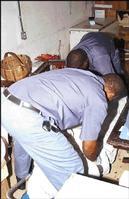
Funeral home attendants removing the body of gay rights activist Brian Williiamson following his death in June this year. - Norman Grindley/Staff Photographer
The following are excerpts from the Human Rights Watch Report "Hated to Death: Homophobia, Violence and Jamaica's HIV/AIDS Epidemic" which was released last week. Human Rights Watch is the largest human rights organisation based in the United States.
SUMMARY
ON JUNE 9, 2004, Brian Williamson, Jamaica's leading gay rights activist, was murdered in his home, his body mutilated by multiple knife wounds.
Within an hour after his body was discovered, a Human Rights Watch researcher witnessed a crowd gathered outside the crime scene. A smiling man called out, "B....man [homosexual] he get killed!" Many others celebrated Williamson's murder, laughing and calling out, "Let's get them one at a time," "That's what you get for sin," "let's kill all of them." Some sang 'boom bye bye,' a line from a popular Jamaican song about killing and burning gay men.
Violent acts against men who have sex with men are commonplace in Jamaica. Verbal and physical violence, ranging from beatings to brutal armed attacks to murder, are widespread. For many, there is no sanctuary from such abuse.
Men who have sex with men and women who have sex with women reported being driven from their homes and their towns by neighbours who threatened to kill them if they remained, forcing them to abandon their possessions and leaving many homeless.
FINDINGS OF HUMAN RIGHTS WATCH'S INVESTIGATION
In Jamaica, state-sponsored homophobia and discrimination against homosexual men and women, sex workers, and people living with HIV/AIDS, the conflation of HIV/AIDS with homosexuality and sex work, and the misguided fear that HIV is transmitted by air or by casual contact are undermining an effective response to HIV/AIDS.
Police not only harass and persecute people suspected of homosexual conduct, sex workers, and people living with HIV/AIDS. They also interfere with HIV/AIDS outreach to them.
Men who have sex with men and people living with HIV/AIDS face serious violence and are often forced to abandon their homes and communities. Many are denied health care; some cannot even seek health services because they are denied public and private transportation services.
And past experiences of discrimination, coupled with the fear that HIV status or sexual orientation will be disclosed and publicised, keep many people from seeking health care in the first instance.
POLICE ABUSE
On the afternoon of June 18, 2004, a mob chased and reportedly 'chopped, stabbed and stoned to death' a man perceived to be gay in Montego Bay.
Several witnesses reported to Human Rights Watch that police participated in the abuse that ultimately led to this mob killing, first beating the man with batons and then urging others to beat him because he was homosexual.
Fred L., () thirty, described the incident as follows: "Me and another guy were sitting on the beach . . .While we were there, some little teenager was on the beach swimming, and Victor, the guy that was killed, was standing looking at the boy. The boy said, 'Why are you looking me like that? You a b....man.?'
"Two rastamen said, "Every day they come on the beach to look at men, b....boy them." Two policemen and a female police officer were there. The two male officers started to beat the man with batons. I turned to the female officer and asked, "What has he done wrong?" She turned to me and said, "Everyday me have to warn people about this guy coming on the beach. I'm going to lock him up." I said, "For what?" She didn't say.
I said to her, "If he did something wrong, lock him up, don't beat him." [Victor] started to run from the two male officers toward the Old Fort Craft Market. The two policemen said, "Beat him because him a b....man." The crowd followed the police officers' lead, beating the victim and throwing bottles and stones at him.
Joseph W., (), 26, told Human Rights Watch that he saw police hitting the victim with a baton and with their fists, and that once persons from the crowd started beating the victim:
"The police officers walked off. The crowd got thicker and more persons started hitting the guy. Then I saw the guy run out of the road into the town. . . . Then I woke up the next morning to hear that Victor was killed about a mile and a half from the beach."
Police abuse is a fact of life for many men who have sex with men and women who have sex with women in all of the communities that Human Rights Watch visited in Jamaica. As in the incident described above, homophobic police violence can be a catalyst for violence and abuse by others. It is sometimes lethal.
ATMOSPHERE OF FEAR
Police abuse is also profoundly destructive because it creates an atmosphere of fear sending a message to other lesbian, gay, bisexual, and transgender people that they are without any protection from violence.
Dennis M., (), 20, lived in Montego Bay. He told Human Rights Watch:
"Police always harass me. . . . They stop you and hear you talk a bit feminine [and ] they ask you personal questions like are you top or bottom and like that. . . . The last time this happened . . . two police came over and said 'B....men mus' dead. You should be under the ground. You should not be living in Jamaica.' Not every police officer does that. Some police officers say it is not legal so you should curtail your behaviour. But most of them, once they hear you talk feminish they begin to bitch [verbally abuse] you and a crowd comes around."
Until early 2003, Peter T. () lived with a group of gay men in a house in Kingston. He said that the police visited the house frequently, making derogatory comments about homosexuality and beating the residents. The police presence would attract others, who would join in the abuse.
He told Human Rights Watch: "By February 2003, the violence had escalated sufficiently to drive Peter T. and his housemates away. "One afternoon, people come and say we can't sleep there tonight because we're going to bomb it down."
Peter T. and his housemates fled, leaving without their belongings.
Police abuse of gay men extends to men living with HIV/AIDS, whom they assume must be gay.
Jamaican law provides broad latitude for police to detain individuals on ill-defined charges, including suspicion of buggery or gross indecency.
The Offences against the Person Act permits a police officer to arrest without warrant any person found 'loitering in any highway, yard, or other places between 7:00 p.m. and 6:00 a.m. the following morning whom the constable has 'good cause to suspect of having committed, or being about to commit any felony' proscribed by the Act.
Women who have sex with women are also targeted for arrest because of homosexual conduct.
Lillie P., (), 36, told Human Rights Watch that she was arrested while parked in a car with her girlfriend on December 31, 2002.
"On New Year's Eve, myself and my girlfriend went to a lovers' spot after a party. There were a lot of other cars there, but the police approached us."
The police called Lillie P. and her girlfriend 'dirty lesbians,' threatened to charge the women with indecent and lewd exposure and asked them for money.
When the women refused to offer a bribe, the police arrested them and took them to the Portmore police station.
At the station, the police told the women that they were not going be charged, but that their names would be recorded in a register.
"It was scary at first because at this point I was not out to my parents and I was going to start a job soon and I was afraid that it was going to jeopardize it. I was concerned for my girlfriend."
She works for [a government ministry] and could suffer problems if they find out she is gay.
Names changed to protect identify