By Donna P. Hope, Contributor 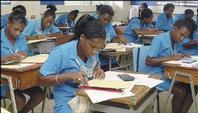
Students going through their accounts exam paper at the Stony Hill HEART Academy. - Carlington Wilmot/Freelance Photographer
THE SPECTRE of colonialism continues to haunt and direct our secondary education system to the extent that we are now at the critical juncture where we must halt and assess the cultural imperatives that form its foundation. While we claim to be more than four decades removed from the clutches of the motherland, our secondary education system today busily replicates and cements the colonial mores that came to us in the guise of the respected 'public school' model and as it developed, translated into the need for external validation of our educational certification and ultimately the entire system.
What exactly is the aim of a high school or secondary level education in contemporary Jamaica? The pundits will glibly parrot the well-known response: "To bring our citizens up to a level of literacy and numeracy that prepares them for the world of work and/or for tertiary education."
The real aim of our existing secondary, high school system is threefold. First, it aims to bring our young men and women to a competent level of literacy and numeracy that identifies them as individuals who have spent at least five years at the secondary level. Second, it aims to provide the curriculum that prepares these students to sit certain external exams - including but not limited to the CXC, GCE 'O' Levels, CAPE, GCE 'A' Levels. Third, it aims to prepare these students for further study (if they so choose) at the tertiary level.
Here, the term external applies to examinations that do not form a part of the internal, ongoing assessment that high school students undergo. These examinations do not form the basis of the school reports that are presented to parents/guardians to report on their children's progress and general academic and behavioural conduct. These examinations are not linked in any way to the useless high school diplomas that are graciously handed out to secondary graduates at high-profile graduation ceremonies at the end of a five-year term of study.
THE "USELESS" HIGH SCHOOL DIPLOMA
High school diplomas are worthless and ineffectual in Jamaica because they hold out the empty promise of joblessness and a denial of entry into tertiary institutions. Our cultural ranking of this educational qualification currently dictates that it cannot stand on its own as a measure of literacy and numeracy. Therefore, while the first aim of our secondary education system is to graduate competent, numerate and literate citizens, the biased cultural imperatives under which we operate create a situation where external examinations predominate and are elevated as the ultimate signifier of achievement and attainment of literacy and numeracy. There are very few (if any) job offers that ask for a high school diploma as the ONLY assessment of competence for even the most nonessential of jobs. Indeed, there have been examples of fast food stores in Trinidad and Tobago that request A' Level passes as the criteria for obtaining entry level positions. In Jamaica, we have the burgeoning demand for two or more CXC passes for even the most trivial positions, with no mention of the high school diploma.
Further, there are no tertiary level institutions to which one can apply for entry, based on a high school diploma and an entry test. The high school diploma is ineffective and at best totally useless because it does not stand alone as proof of certification of an individual's competence at even the most basic level, but must be supported by proof of passes in key external examinations - CXC and GCE at least at the ordinary (O) level and usually in certain subjects - English, Mathematics and a Science subject. This demand for higher qualifications forces up standards in general and maintains notions of educational superiority, but it marginalises and invalidates the high school diploma and, ultimately, those carrying it.
The cultural biases and norms which obtain in Jamaica today are directly correlated to many cultural cues from the U.S.A. Our lifestyles (dress, food, cars, etc.) mimic that of the U.S.A. and we are quick to compare our living standards to that of America when it suits us. Therefore, let us seek comparisons with the U.S.A.'s system of education. America's high school diploma, the G.E.D., is accorded overwhelming levels of respect, both as a marker of significant educational achievement and as a valid qualification for job seekers.
Many Jamaicans who migrate to the U.S.A. are forced to re-evaluate their once 'useless' high school diplomas, hurriedly requesting express-mail or overnight packages of transcripts and/or copies of these previously discarded certificates, which now hold significant educational capital in the U.S.A. Let us recognise too that where external examinations are concerned, the American Scholastic Aptitude Test (SAT) does not compete with the aims of the high school curriculum but operates in a supplementary and distinct space. The American G.E.D. is invested with its own educational and social value as the crowning achievement of the American high school system. The SATs, on the other hand, are accorded a different signifier, as the external examination whose results mark the first steps on the transitory path to gaining a college or university education.
THE EXTERNAL EXAMINATIONS
In the context of Jamaica and the Caribbean, however, the introduction of the Caribbean-based examinations, the CXCs, in 1980 was ostensibly to break the dependency on the British-based GCE exams and provide Caribbean citizens with their 'own' method of assessing education at the end of the secondary level. However, the CXCs simply mirrored the divisive colonial tendencies that Caribbean societies were struggling to divest themselves of. At the outset, attaining a Grade 3 in the 'local' CXC General was deemed a failure by the educational authorities though a corresponding Grade C in the 'foreign' GCE was accepted as a valid pass. This breach was remedied only after several years of intense outcry and lobbying by both parents and educators. Yet, this cultural urge to elevate to higher and more acceptable ranks and to place more value on things 'foreign' remains entrenched even in the 21st century.
There are many instances of individuals being denied access to sixth forms, tertiary institutions and jobs because their CXC passes included too many of the dreaded Grade 3. That a Grade C at GCE remains acceptable, while a 'Grade 3' at CXC is still viewed with suspicion and downright contempt by many parents, students, teacher, educators and educational administrators means that in theory a change has been effected but our "colonial" perception of its 'uselessness' remains unaltered.
The tensions between the ethos for external validation and the need to develop working and useful systems of secondary education, underscore the prevailing competition in Jamaica between external examinations and the high school diploma. The high school diploma has, in effect, lost out to the external examinations as the ultimate symbol of completion of secondary education. It is, therefore, imperative that we begin to critically evaluate the role and use of secondary education in Jamaica.
WHITHER SECONDARY EDUCATION?
What exactly is the role of our secondary level institutions? What is the real value to be afforded to the five or so years that students are encouraged to spend in these schools? Are we spending taxpayers' money to prepare our citizens to be a valuable and viable part of the working world in Jamaica? Or are we insisting that our educational system is too weak to inculcate in our students the necessary skills and knowledge that guarantee them entry level positions in the world of work from which they can chart their chosen career paths? Is it that our high schools spend five years only to prepare our students for external exams? If this is so, then is there a real social need to maintain a huge network of secondary level schools when the critical focus is only on Grades 9-12 when students are grilled for external examinations? I believe that there is now an urgent need for a radical review of the curriculum and aims of the secondary education system.
It is the ultimate responsibility of the State to ensure that more value resides in that piece of paper called a high school diploma or school leaving certificate. This piece of paper must be moved from its current useless and ineffectual status and uplifted to stand on its own as a marker of a functional and beneficial level of education.
Additionally, the dualistic and competing goals of high school diploma versus external certification must be clearly distilled and melded into a composite whole. Students should work towards these two related but distinct aims with greater clarity and a stronger sense of purpose. This will ensure higher levels of personal success and stronger feelings of achievement.
As we move farther into the 21st century and seek to market Jamaica as the highly trained and educated society that it rightly is, radical structural and curriculum changes must be immediately effected to ensure that our country's investment in education is not negligible, remaining prey to deep-seated cultural imperatives that hark back to colonialism. Sovereignty ultimately means having the wisdom, courage and political will to make the changes necessary to validate our systems of learning, invest real educational, cultural and social capital in our methods of certification and articulate these changes across our society as a whole.
Donna P. Hope is a doctoral candidate in Cultural Studies at George Mason University. You can send your comments to infocus@gleanerjm.com