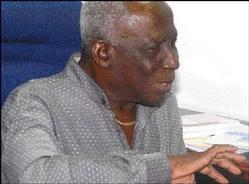
The following is the second part of an interview with Professor Rex Nettleford conducted by Senior Gleaner Writer Barbara Ellington. Part one was published in yesterday's Gleaner.
BE: The state of our education is always a sore point, more so recently with the Minott Report that showed disturbing findings. What do you see as (a) the problems and (b) what are the possible solutions. I see it as a paradox because on the one hand, overseas employers eagerly gobble up our trained professionals. We must be doing some things right, we excel well outside this country - what are your views?
RN: I join Professor Errol Miller in saying all this nonsense about our education deteriorating is not true. You have just stated what happens when we go away. Maybe there is something in this society which doesn't challenge some of us sufficiently. Taking a child through years of schooling and university doesn't challenge him, it prepares him to move on and he has to be challenged when he gets out there.
However, let's not go into denial; our teachers and training colleges need all the support they can get. We need to produce fantastic teachers the kinds of teachers who will not only train but educate. The kinds of teachers I had. They also have to be better paid and the society has to be prepared to spend money paying them.
The other thing is that with the expansion of the economic base, the schools were robbed of an entire generation of teachers which went into the insurance industry and social work. And, a lot of our men do not go into teaching. I am not knocking the women, my female teachers were fantastic, but we did not have the complaints about them that I hear now. They make the boys feel less than good. I am just reporting, I have not done the research.
I hear that our primary schools are not male-friendly and the result is that the boys drop out early. So it's no surprise that 70 per cent of the students at Mona are women. They have followed through.
The numbers is another thing. There are just too many students in a class. The rearing of our boys is another factor. I was always a great advocate of boys and girls being in elementary school together but at the teen years, they should be in segregated schools, then they can get together again for tertiary education.
So the education is a bigger social problem than just the schoolroom; all of this will have to be addressed by the Minister. We are thinking about it. We have to think also about this gender thing. Why do you have some fellows who will beat their wives and girlfriends but still love their mothers?
BE: Since you are going there, let me ask, what do you think can be done to help our men be real men, responsible men, human beings who do not abdicate their responsibility to women, real men who transfer their love for mothers to their wives, girlfriends, sisters and children. Why are we losing our men?
RN: We keep talking about absent fathers but it's not just that. They may not be frequently present but they visit and we have surrogate fathers too. I grew up in a village where everyone was my parent.
There is a Guyanese proverb which speaks to child-rearing, and it says, "Tie the heifer, loose the bull and while that heifer is tied, she learns to live on the law and on the grace." The 'leggo beast' is out there fending for himself without guidance or love and that is supposed to be manly. He continues through life without any sense of commitment to anything; it's the way you are reared.
Many of us who come from country see things grow; we understand process. The male is not exposed. In the area I was raised, mothers would run the boys out of the kitchen with the words 'No look eena pot, you wi tun mawma man'. The girls had to lift the pots, wash them and do housework. That's ridiculous.
I feel that boys should learn to do all this; in any case, when they go into the army, they have to learn to do them. It's the rearing.
In the employment arena, I have found that it takes longer for the induction of a male in the simplest job, than a woman, because she catches on faster.
BE: So why are men still ruling, running all the boards and corporations and in charge of all things important? Why is it such a big deal when a woman gets a top board appointment?
RN: Because you women are reluctant debutantes, it's amazing. That's why feminism has not taken on. Because you protect your men, we are all potential 'sons', it seems like a psychic thing; that's the only way I can explain it. The feminism of white north American women has not quite taken on in this region. There is a sort of protectiveness about black women for their men and it's not simply sexual.
We entertain lots of myths too. That Bible, the things it has done to us. For example, the notion of the seed of Israel, even in the Rasta movement, it's about sowing seeds as though they can germinate on their own. There are certain practices which have to change in the society.
I have asked corporate entities to get men and women on the floor working together and doing the same things, not women being supervised by the men. Many men object to this because at home, in school and at Sunday school they are dominated by mothers and female teachers. Where, then, can they be 'man a yard' but in their own house? Even if the woman is paying the rent, he wants to maltreat her. Some go as far as to say, 'In the workplace me is bwoy but in mi yard me is man."
BE: Others speculate that female dominance at work causes some men to go home and take out their anger on their wives, do you agree?
RN: Yes, one could speculate on that but I feel it goes back to child-rearing. Even in homes where you have a nuclear family, women will not discipline the boys but say, 'Wait till your father comes home.'
I was lucky to be brought up in the country where I saw trees grow, I am able to understand cyclical things - when I reap a banana, that tree dies but there's a sucker growing in its place. I understand that the moment of maturation is the moment of disintegration is the moment of regeneration. When a ripe fruit falls, other trees will grow. Growing up in rural Jamaica made me understand all of this and to respect adults by referring to them as 'ma'am' or 'sir'.
Greeting each other as persons is important to us, it gives us a sense of ownership of ourselves. History has taught us that although we were slaves, we must never go back to that.
BE: Your analogy about the tree and understanding life was also used to teach us responsibility for something. Each child was given a tree or animal that was theirs for life. Was that the same for you?
RN: Yes, it taught us to relate to our environment and I think that we have not done enough work on the effects of urbanisation. When I came to Kingston, the rural population was bigger than Kingston's, it's the opposite now. But my peers here didn't relate to the environment like I had learnt to.
BE: So to get back to why men aren't real and caring people, is it perhaps because of inequitable parenting of boys and girls?
RN: Yes, we should now use modern technologies to bring back equality between genders. Once upon a time only women typed; today, everyone uses computers so men are also typing. This male thing is rooted in insecurity and the notion of being overpowered.
I am happy that we started gender studies at the Extra-mural Department because we are very conscious of them. The university must now revisit them and go in depth to use them to help the society to heal itself.
BE: We digressed, let's revisit education; what's your take on the level of CXC passes?
RN: It has to do with teaching, they are not being properly prepared and the teachers themselves are not properly prepared. But I don't think this makes the children dull. We still manage to figure among the top 10 in the world in A'Levels, etc.; it means that a lot more emphasis has to be placed on preparation. Find ways and means of reaching all the students. CXC is not the easiest exam to pass.
BE: So, what does a busy professor do for fun?
RN: Dance and read. I am grateful to my dance, it forces on you the preparation of the body as an instrument of expression. When I travel, I walk a lot, no taxis or buses, I walk, it's great exercise.
BE: What about diet, how do you keep so trim?
RN: I eat everything and I'm very Jamaican in my diet. I can't feed some of my friends who don't eat this or that (he laughs), I don't have those problems. Some of the people of this country have tastes beyond what we produce. It's my country upbringing, as a child I ate a lot of guavas only to learn of its high vitamin content.
Things like Seville orange roasted and eaten with sugar was excellent for colds, I had many bush baths and other home remedies as a child and many of them still work for me. I remember seeing adults use blue for cuts. I was blessed to be exposed to Jamaica. I was there just when opportunities opened.
BE: Who helped discover your brilliance? When did you know that you were a gifted child who took to learning like fish to water and so well rounded at the same time?
RN: When things were opening up, was there, I got the one scholarship being offered. The arts came naturally to us in the country; we had to amuse ourselves with moonshine baby and ring games, after the hard work we had to recreate entertainment. I never heard a radio before I was nine. We drove the parakeets from the cornfields by beating pan and singing folk songs.
At school there was spelling bee and my grandmother and mother insisted on school and education because that could not be taken away.
BE: Are you an only child?
RN: No, I have two sisters who are nurses overseas and a brother who is deceased and my mother is still alive and living in New York. She's 95. She loves to cook and she always has food for me when I go to visit her, whether I want it or not, but she insists, "Go wash your hands."
BE: What is your wish, dream, desire for Jamaica?
RN: Our people, I want to see our people get back whole and the next generation to understand that they are operating in a large environment. Despite the idea about the concentric outer circle of a globalised world, in a real sense they can occupy a space that gives them a sense of place and purpose. I am not giving up hope but it has to start from the core of how you are brought up.