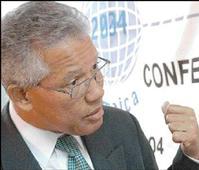
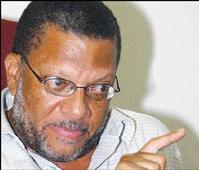
BRADY and PHILLIPS
Earl Moxam, Senior Gleaner Writer
THE NATIONAL Security Strategy Committee, a multi-sectoral task force on crime, is expected to report its findings and recommendations to the Government in November.
National Security Minister Dr. Peter Phillips, who will receive the committee's report, is expecting to be advised on some of the major security threats the country faces and the appropriate strategic responses.
The committee, chaired by former Chief of Staff of the Jamaica Defence Force, Rear Admiral Peter Brady, has been reviewing, among other things, the operations of various government agencies and how these impact on the overall crime fighting effort.
PRESENTED TO CABINET
Following review by the National Security Ministry, the report will be presented to Cabinet. The recommendations which are accepted will then be implemented.
Dr. Phillips, concerned about the growing threat of the drug trade, told The Sunday Gleaner that agencies such as the Customs Department and the National Land Agency were important to the review process because of the potential for money-laundering operations through these areas of economic activity.
"Money laundering through property transactions would probably show up in an agency like that (National Land Agency) or in the Registrar of Companies. I have made the point that our political institutions, our security forces, our public bureaucracy, our financial institutions, our commercial institutions, all are under threat," the Minister asserted.
The overall aim, Dr. Phillips said, was "to see how we can create a seamless web of relationships within the apparatus of government that we can enhance our security overall."
With approximately US$4 billion worth of cocaine passing through Jamaica last year, a significant portion of which is estimated to have remained in the island, Dr. Phillips warned that the trade represented "a real threat, in its illegality, to other, legal activities".
The National Security Strategy Committee, appointed earlier this year, is a multi-layered body, at the apex of which is a steering committee, including the Permanent Secretary in the National Security Ministry, the Cabinet Secretary, the Financial Secretary, and the Head of Customs. There's a working committee drawn from rank and file officers in these ministries and departments, and a panel of international experts drawn from the United Kingdom, the United States and Canada.
The committee's review is being carried out against the backdrop of a worrying upward trend in crime, with the number of murders this year more than 800 to date.
Dr. Phillips, in a frank admission of the gravity of the situation, described it as "a very bad situation as far as escalation in the murder rate is concerned."
ANALYSIS
In his analysis of the situation, the Security Minister said that a third of the murders committed so far were attributable to domestic disputes; while roughly a quarter were reprisal killings, some of these related to gang rivalries and fights over drug turf in areas of the country such as Montego Bay, Spanish Town, and the police division of St. Andrew South in the Corporate Area.
According to Dr. Phillips, the country is partly paying the price for the success it has begun to have in striking out elements of the drug trade, "which have generated greater competition over what are scarcer resources around some of these gangs. As the drug money has become more difficult to come by people have intensified their extortion efforts and other kinds of criminality."
But there was no alternative, he warned, to keeping up the pressure on the drug lords, arguing that "the mayhem would be much worse over time if we allowed the entirety of the society to fall into the grips of the drug trade because it drives out legitimate business activities, and is doing so now."
The country, he said, was "living in the midst of the adjustment that has to be made."
In keeping with that resolve, he said that there were more police than ever on the streets, with the establishment now up to 8,500, of which 7,500 positions have been filled, while an additional training centre has been established.
He highlighted as well the recent creation of the Organised Crime Investigation Division (OCID), the National Intelligence Bureau and the reorganising of the Narcotics Division as some of the other measures that are being put in place to confront the crime problem.