By Avia Ustanny, Outlook Writer 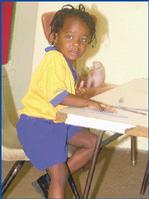
WE DO not know how to say good morning in sign language, but we quickly learn how to, when more than one dozen tiny children surge forward like a rolling tide and bend their arms upwards with the greeting, demanding a response.
Twenty-eight children ranging in age from one and a half to six attend the Jamaica Association for the Deaf (JAD) Pre-school Centre.
We have interrupted their devotions this morning and soon depart to speak with school supervisor Sharon Andrews, who wants to talk about the kind of parenting which deaf children of all ages need.
The JAD programme is a parenting programme in the beginning as they seek to teach parents how to teach their children at home.
However, activities at the JAD Pre-school have become more focused on kindergarten activities as the children are coming to them later and later. Parents are becoming less involved.
Ms Andrews quite understands the challenges they face, but wishes that things were otherwise.
Emotional
"Parents become extremely emotional when they are told that their child is hearing-impaired. They go through the whole thing of looking for a cure, a period of extreme anxiety," Ms Andrews told Outlook.
"They are in denial at the beginning and they blame themselves a lot. I used to work on the social service side and observed that they do not listen, they are not hearing what you are saying.
"They go into a lot of guilt. Why did it happen to me?
"Later they go into shock and depression. They go to many places seeking alternatives. Some carry the whole denial thing all the way to high school. Some also feel that a hearing aid can fix the problem. They also feel that one day their child will talk."
Here at the JAD, where the programme also involves speech readiness and speech training, parents are delighted when their children mouth words, but they soon use it as an excuse to think that it is a sign that they will soon be completely normal.
Lurline Headly, supervisor of the Danny Williams Primary School for the Deaf, comments that society is also very cruel to parents of hearing-impaired children.
"They tease them a lot and say it is something they did why their child is deaf. They suffer. There is still a lack of public education and counselling at this early stage."
But, the educator adds, parents also make the mistake of isolating their deaf children, thinking that they are protecting them.
They may also put off enrolling them in a specialist centre, waiting to see if language will come. This is further complicated by the fact that many doctors, especially in rural Jamaica, do not automatically refer parents to specialists.
According to Ms. Headly, deafness is a reality which parents must accept.
"The child is not hearing and will go through life with this situation. You (the parent ) need to get counselling. Your child will need early stimulation and also need to learn how to function in a hearing society.
Sympathy
"The deaf do not want your sympathy. What they want is understanding. Apart from being deaf, nothing else is wrong in most cases. They will develop physically in the same way as other children. They have the same needs and the same concerns."
The primary school supervisor is concerned that some parents tend to pamper their deaf children too long and allow their deaf children to get away with things.
Other parents neglect them, having the idea that if they spend money on their deaf child they will not get the same returns that they would on a child who does not have this impairment.
Sign language
Sharon Andrews of the Pre-school is concerned that less than ten per cent of parents with deaf children make the effort to learn sign language.
This presents a great problem, as the deaf child yearns to have complete conversations and very often cannot do so with those closest to them.
They also learn that they are different from their other siblings, as they are excluded from so much of the communication and activity that go on in the family.
"When they go home they are all by themselves, watching TV alone. No one interprets for them," Ms Andrews said.
Being excluded will lead to low self-esteem in the deaf child, the educator states.
"The deaf child wants to know everything too, including their responsibilities. Lack of communication hinders this," she added.
"Parents cannot even ask 'where is your bag?' and 'do you have homework?' They believe they can just talk at them and point at things and they will understand. But, in terms of helping the child to be literate and numerate and having a good conversation, they must learn sign language."
Ms. Andrews is also concerned that when the children begin to approach puberty, it is their teachers who provide them with information that they need. The parents cannot do it, again becasue most do not take the trouble to learn sign language.
According to Ms Andrews, "We plan sign language classes but often only 2 parents turn up. Most of those who come are outsiders."
Often the excuse given is that they have to work, or that the children themselves will teach them. "Often their children are telling them bad words and they do not know. How do you teach them values if you cannot communicate?"
A lot of parents complain about the costs attached to the care of their deaf child. Hearing aids range in cost between $17,000 to $90,000 each. These also have to be maintained. The education of deaf children also costs more.
Other parents live great distances away from the schools that can educate their children and just cannot afford the stress and expense.
But, there are still others who can afford it and use toys and gifts to compensate for the lack of their own attentiveness.
Obey
"In the last three years, we have observed that parents are not teaching their children to obey," says Ms. Headly.
"These children are smart. intelligent. They are just like normal children.
"They do not hear, but they see. They are very visual, that is how they learn. They hear with their eyes. They see every change and want to know the reason for it," she stated.
The challenge of parenting deaf children is not to be underestimated, but those who work closest with them say that the rewards of learning to communicate and meet their special needs are just as great as with any "normal" child. For every parent affected, that is something worth thinking about.


















