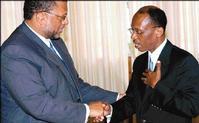
Dr. Peter Phillips, left, Minister of National Security, greets Jean-Bertrand Aristide when the former Haitian president made a
courtesy call on him last week. - Rudolph Brown/Staff Photographer
The following is an excerpt of a recent interview that Radio Mona's Michael Anthony Cuffe had with the exiled Haitian leader, Jean-Bertrand Aristide and his wife Mildred.
M: I'd just like to start out President by asking about your stay in Jamaica, how has it been.
A: First of all I have to say thanks to Prime Minister Patterson, the government and the Jamaican people. It's a very special time for us, we appreciate the warm welcome and this time which is as I said a very special one for us. So we say thanks for all that.
M: You are used to meeting a lot of dignitaries, interacting with a lot of people in general are you missing any of the normal routine of day to day activity?
A: I try to be living in deep communion with the Haitian people, and with billions of people suffering throughout the world. When we have so many people without food because they have to live with less than US$1 a day; when we have so many people faced with HIV or other kinds of diseases; when we have so many jobless in the world. Of course living in deep communion with them means sharing their suffering and accepting our personal suffering as part of the global one. That means for me, yes it's a special time, but I don't see it as bad to be complaining about it. I embrace it. I assume it and I try to say, well, I am living in a house, what about so many others who cannot find a house to live? I can eat. What about so many others who are spending days without eating well or finding food for their children. So this is an expression of love moving and living this way?
M: Describe your average day for me President
A: Most of the time I write, because before I didn't have so many hours free to write. So I enjoy writing and I can say basically, I spend days writing, thinking and this is fine.
M: What are you writing about
A: I won't say too much now.
M: A book?
A: It's a book which will be telling readers about what they are eager to know. For instance, what happen on February 28, 29, so I will not talk too much about for the moment.
M: Have you been listening to the news much? You know that a lot of your people have been coming to Jamaica, have you had a chance to meet any of them, what are your thoughts on that?
A: As a matter of fact, when I said a couple of minutes ago that I have been living in communion with the Haitian people and so many others abroad, I have in my heart, not only in my mind. Watching news, seeing them on T.V, listening about them on radios. This is a way to share the reality when someone had to flee political repression with a boat, knowing that he can die. So I am connected to them, sharing the suffering, we don't meet in the physical way, but we are in deep communion of heart and spirit.
M: I know the large part of your experience has been in the priesthood, I couldn't help but wonder if you still maintained any of those practices that you used to engage in as a priest some time ago.
A: Yes. Because for me there is no dichotomy between serving as an elected president now, or years ago, serving as a priest. Because if you don't love the people and you say you believe in God you are lying, says the Gospel. Serving means you love them and you do your best to make them feel happy, if they don't have bread, whatever you can do to share with them or improve the quality of life such a way for them, dignity to have bread. As the President, risking your life, to protect principle, democracy, to avoid a situation where you may move from coup d'etat, 32 and the last one 33, that was the way to serve, while you face the danger, the danger is what happened on that night, February 28, but you assume your responsibility in order to keep the country in a political and stable environment, such a way to promote economy growth, while you are investing in human being.
M: Was that what prompted you President Aristide to make the move from becoming a priest to entering the realm of politics
A: It was an accident, because days before I never thought that, that could happen. I remember that in 1990 I was here in Jamaica, and I grasp this opportunity to thank a friend of mine, Father Jim Webb, a priest, who recorded the time and who helped me to think of it through a videotape. So while I was here in 1990, I didn't know later something could happen, becoming candidate and then president. The people wanted me to be their candidate to run for presidency, I hesitated, I thought it was a foolish idea. I thought it couldn't happen, it couldn't be possible, but a priest and bishop convinced me, and then I assume, once I assume, I fully assume, that means I don't regret what I did. So moving from serving as a priest to becoming president, still serving, this was an accident as I said.
M: What was it that
convinced you?
A: I can say a priest, for whom I have a lot of respect, despite of what happened to him because he passed away. Father Antoine Adrien. When he realised that I didn't waXnt to hear about that kind of idea, then he invited me to have dinner with him, then he convinced me. But then I went back again and I said no. Then I got a call from a bishop telling me that he thought I should accept as a sacrifice, and then I accept.
M: What is the legacy, that you would have left as President of Haiti.
A: I think you will find the real answer in the book I am writing right now. I can just for the moment, make one comment. We moved from coup d'etat to coup d'etat. And we had 33 coups d'etat including the last one, we wanted to move from elections to election. That means the first time we had free fair and democratic elections was on December 16, 1990 and there, the huge majority of the people, who were oppressed for the first time could say, 'Now I can vote', again we went to election, and we continue to move from elections to elections, passing from one elected president to another one, as I did with President Peral and so and so. The minute you want that to happen, what do you have? You have a tradition of respect, respect of human being, one man one vote. Everybody counts. One of my books is Everybody is a Human Being. It says if you are a human being, you have your rights, so you have the rights to vote, how I could prevent you to vote, if I want to prevent you to vote, that means I did not recognise you as a human being, and this is what we had in the past, and as a legacy, this is what we have now. As a matter of fact, the people are aware about their rights to vote as human beings, and they refuse to stay out of the game, and they said no to violence, yes to democratic elections, and those who fear elections, they refused to go to elections. They do not fear Aristide, they fear the votes of the people. That's the reality.
M: Final question President, your own future, how do you see that now?
A: I think the future is linked to all that I just said somehow. But I expect to leave in a few days to go to South Africa, and despite of the distance, we will always have Jamaica in our heart, Haiti in our heart, so many brothers and sisters in our heart. I will continue to write, and of course with all that in my heart.