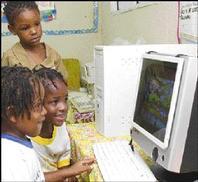
Teachers should find creative ways to present lessons to students, such as via the computer. – File
The following is an edited version of an address by Senator Professor Trevor Munroe given at the North West St. Catherine Annual Teachers' Dinner at Dinthill Technical High School on May 8, 2004
ONE OF the things for which I am most eternally grateful, and for which I ask you to be grateful to your teachers, is the imparting of a capacity for critical, independent thinking. For 'picking sense out of nonsense', for seeing nonsense in what sounds like sense, for fairness and balance in what we see and project, balance in how we judge and evaluate, for courage to stand up for what is right.
Take the charge that teachers in Jamaica are under performing of course there are many of your colleagues in North West St. Catherine schools, my colleagues at the UWI, and members of our profession across the island who are not performing up to standard and we must call them to account. By their negligence, they are carrying down all of us, giving our profession a 'bad name' and our students 'short-change'.
GOOD RATINGS
But having said that, in the interest of balance, should we not have recognised two things more than 90 per cent of Jamaican parents rate the schools in which we teach and over which we administer as very good (42.8 per cent) or good (48.6 per cent). [Taken from the Jamaica Survey of Living Conditions 2002, 3: 11-12]
Should we also not recognise, in the interest of balance, and in rejection of bias, that the students whom we graduate as much learn what we teach as they learn what they live. So we teach peace in the school, many live war in the community. We teach tolerance in the classroom, many live intolerance at home. We teach discipline in school, many live indiscipline at home. We teach how to think and how to reason, many live how to be 'seen and not heard'.
And so, we teachers cognizant of the inter-connection between what we teach, how the student lives and what the student learns have to continually improve our skills to cope with this complexity even as we have to urge the society to better understand that what comes out of the schools is as much the product and the responsibility of the teacher as it is of the parents/guardians, of the community, of the media, of the society.
A GREATER CHALLENGE
And the fact is that our task is made even more challenging by the irreversible reality that our society, our world is not changing; the society and the world have changed for better and for worse.
Take the technologies of communication, of entertainment and of information transmission. From inception to the first 50 million users it took Radio 38 years; the personal computer 16 years; TV 13 years; the World Wide Web (Internet) 4 years. Take the telephone it took Jamaica almost 10 years to get 500,000 landlines, yet less than 10 years to get to well over one million cellulars.
The pace of change everywhere in everything is increasing. The multiplication of sources of information and of entertainment, of urbanisation, of travel, of migration, of breakdown in family structures- all these pose new and continuously evolving challenges for the formal education system, and in particular, for teachers and others involved in the learning process. The main challenge is to change with the times while retaining the positives of the past. And one of the changes we have come to grips with both here and abroad, is the introduction of performance evaluation and of performance based compensation- not just for teachers but for education administrators as well in the Ministry.
SECURITY 'FOR LIFE'
In days gone by this was unheard of. Once you were certified, that was it seniority more or less took care of promotion. No longer is this acceptable in a world of less borders and more competition where 80 per cent of education budgets go to salaries. Even at the tertiary level, when I entered the profession, once you became a tenured professor that was it security 'for life'. Now no longer there has to be peer group evaluation, and on the way to becoming a professor, there was no question of student ratings being considered. Now, everywhere student evaluation is being introduced and taken into account for purposes of promotion.
The point is there is no way of getting away from performance evaluation and performance- based compensation in the modern world. What we have to make sure of is that there is full discussion at all levels of the particular methods to be used, that there is as much buy-in as possible by teachers, students, parents and the entire educational community.
There is much literature on this and considerable experience in different methods of teacher evaluation and self-development. (In the Ontario system, for example, teachers have to be re-certified every five years and professional development is mandatory as is parent-student involvement in appraisal.) The point is we need to urgently study experience elsewhere, match it with our needs, discuss fully what methods should be customised to suit Jamaica's circumstances and then, once there is buy-in, we have to implement!
THE EVE OF IMPLEMENTATION
And we are now, as I understand it, on the eve of implementation. A pilot programme is now being tested and pending the result of that test, the Teacher Performance Evaluation System will roll out in September. We should discuss and modify as we go along whatever needs to be changed in that system but support it we must if we are to live up to the traditions of our great profession. One of these has been to accept the challenge of change and to play a critical role in constructing new social orders.
Our profession did just this in helping to build a free Jamaica after emancipation, 170 years ago.
Our profession was a pillar of the struggle against colonial rule, in imparting to the pre-independence generation confidence in their capacity to take charge of our own destiny and to manage an independent Jamaica.
Once again our profession
is now called on, in the
radically changed circumstances of globalisation:
To help to transform not just the educational system but Jamaica as a whole
To help give our students a sense of self-worth, of self-esteem, of pride in the achievements of Jamaicans, in the rich heritage of our people and our land;
To help develop in our student-citizens a willingness and capacity to better themselves and their families by overcoming the adversities and seizing the opportunities presented by this new world but at the same time to give something back in service to Jamaica;
Most of all, to use the resources provided by the society- as a proportion of our Gross Product greater than most countries, to help reduce inequality in the educational system and in the society as a whole, thereby helping to reduce social tension, reconstruct social order and build sustainable development.
I am confident that teachers will rise to the occasion.


















