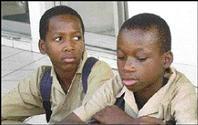
Students sitting on a sidewalk in Half-Way Tree. – File
The following is an edited version of an address made by James Moss-Solomon to the Rotary Club of Kingston on Thursday May 27, 2004
IN RECENT weeks, the much-publicised survey on secondary schools done by Dr. Dennis Minott has evoked large and varied discussion in the media and at the policy level. In spite of the general unavailability of the survey details, the response has been overwhelming.
Persons from all walks of life, persons within the education system, professionals in the diaspora, parents and guardians, and the general public, have found themselves engaged in discussion, even without having the necessary facts. I therefore, congratulate Dr. Minott for stimulating a level of discussion and interest, which has engaged our entire population in a way not previously experienced.
KEEPING INTEREST ALIVE
The important ingredient at this stage of the debate is for us to keep that interest alive. In order to do this we have to find ways to keep the dialogue open to facilitate contending ideas, rather than letting the level of discussion descend to merely being a contentious subject. Too often, important ideas are lost in the urge to have confrontation, rather than using our faculties to reach a meaningful consensus.
This is a situation too often encouraged in the media and elements within the political directorate, which promote sensationalism rather than good sense, and hysteria over effective action. This includes active talk about free education rather than the quality of that education by our two major political parties at a time when the Government is unable to even properly fund the current system. This educational debate cannot be allowed to degenerate into a position where everyone defends his or her turf, to the exclusion of all possibility of making the necessary changes.
No one can say change is easy, especially when dealing with social situations of long-standing which may no longer be relevant. History is full of good ideas which have been shelved in order to avoid confronting norms which have outlived their useful time. The horse did eventually give way to the automobile, but not without some kicking and screaming, the remaining toehold being the fact that hotels, by law, still have a hitching post for mules.
CHANGE OVERDUE
I am not going to pretend to be an expert of any kind, except I must help people to realise that change in education is necessary and long overdue. It goes beyond the realm of being an acceptable political football, and must now enjoy support across party lines in forming some national consensus. This could be the first opportunity for our political leaders and the general population to form a national agreement and direction, which can last beyond the life of a particular elected government. If this could happen, imagine what would be possible in charting a totally new road for education.
Whether you agree with Dr. Minott or not, one thing is certain. Education today is inadequate for a modern world and requires radical change, total change, and not incremental adjustment.
In order to illustrate this, let us look at education as a business, and as a service business in particular. Based on current analysis it would seem that this industry is not successful and is in fact bankrupt, as the output is not in keeping with the desired results. Therefore, we have to examine the entire structure of the industry in order to determine whether or not there is a need to change the industry itself.
Here are a few questions, which need to be ventilated.
What are the desirable characteristics of a properly educated person within a rapidly changing global environment? We need to bear in mind the fact that job content changes so frequently, that young people will have to make many adjustments over their working life, and therefore probably need a broader basic education in order to facilitate mobility.
Since the industry requires both teaching and learning, are our teachers properly prepared to impact the required skills for this new environment, and are our students properly empowered to learn under their own initiative?
Do we have the necessary social mechanisms to bring out the best in our students? Do they have proper facilities at home, and do they live in communities that are conducive to learning?
At various developmental levels, do we understand what the desired ratio between teachers and students should be, and the total additional cost of both teachers and infrastructure within these requirements?
Do we accept that education is a process, which is not only confined to a classroom?
Do we accept that education is a professional field and not a political process? Do we have adequately trained teachers who can lead a new system or will we have to restrain everyone?
These are some of the general questions to be asked in helping to determine the extent of change required within the industry.
It would be remiss of me not
to briefly mention the gender disparity, which seems to affect the performance of boys in a negative way. The debate needs to include some of the following facts which affect the development of boys and which are not being adequately addressed. A few of these are:
Boys' development and maturity up to a certain age lags behind that of the girls. Therefore, a system which places identical age groups and their expectations on par needs to be reassessed. Any future system must account properly for this basic differential.
The physical maturing process in boys releases much more energy through their hormones than is released in girls. Therefore, much greater amount of physical activity is required to dissipate these energy levels in wholesome ways, rather than in the many destructive incidents often featured in the media.
The composition of the teaching staff in a boys' school needs to provide more suitable male role models than are currently available. This compounded with the large numbers of very active boys who are under the charge of women teachers, often provides an environment conducive to inappropriate behaviour, and also fosters a negative view of boys who are interested in sports more than academics.
Social conditions in many areas encourage boys to give in to peer pressure, in that, as soon as they seem old enough to be perceived as able to carry a gun, their freedom of movement is effectively curtailed. So while you may see little boys and girls neatly dressed and going to school in harmony, the same does not hold true for the teenagers the girls hold the education, but the boys hold the corner.
The reduction of boarding facilities has also reduced the level of 24-hour supervision of schools, and has denied many students who do not have adequate home environment, of a place in which they can excel.
TERTIARY EDUCATION
I have indicated many areas that need urgent attention. But I will only leave you with one recommendation. We need to have a common, long-term, measurable goal for Jamaica that every citizen can appreciate, buy into, as well as support. This must be in keeping with our perspective for our future in a rapidly changing world centred around information. At the same time it must be broad enough to allow shorter-term initiatives to be undertaken, and measured, and must promote political consensus.
I am, therefore, recommending that we set a goal of having 70 per cent of our population completing a tertiary education by the year 2030. I am not at this time even attempting to suggest what will constitute a tertiary education in the future but would suggest that it could include our current definition of the traditional tertiary education as well as treat with any broadening of scope which may be developed, invented, or envisioned in the intervening 26 years.
I believe that every Jamaican could subscribe to these or other similarly broad objectives. It effectively eliminates political in-fighting, allows for the debate of shorter-term action plans, interim measurable goals, while still moving towards the broad long-term objectives.
I thank Dr. Minott for shaking-up the status quo sufficiently for us to engage in meaningful debate. And, I thank the many persons who will now come out of the woodwork to enhance the quality of discussion and who will eventually lead that necessary revolution in education that our generation must undertake in the interest of our children and grandchildren, the nation, and the region.