By Tanya Batson-Savage, Staff Reporter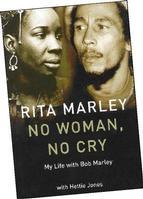
FAR TOO much of Jamaica's musical history has been recorded by those from outside of it, and so Rita Marley's autobiography Rita Marley No Woman, No Cry: My Life With Bob Marley could have been an interesting addition to the body of knowledge that exists. In a sense it could have been the Lady Nugent's Journal of Reggae. Alas, could-have-beens cannot get us beyond what is. Unfortunately, No Woman, No Cry only amounts to a detailed sketch.
Having left the musical legacy that he did, Bob Marley's life is ripe for producing a plethora of books. As he is forever silenced, those who lived with him can take the time to tell his story, their story and as many versions as can be told.
Part of the problem with biographies, and autobiographies especially when the real reason for giving one's autobiography is because of how it related to another person is that it bears the stench of going through somebody else's garbage to find out about their lives. In Rita Marley, No Woman, No Cry, Rita is sifting through disposed and disposable
memories of her life with her husband.
Even so, Rita's story is one that should be told. History has already forgiven Bob Marley all his indiscretions. We blithely say that at least he took care of his children, despite the fact that he seemed to have taken the edict 'be fruitful and multiply' as a personal challenge. The truth is, while he was running hither and thither and yon, he had a wife. One must wonder, what it was like for her. If nothing else, No Woman, No Cry answers that question.
But answering that question is not enough. No Woman, No Cry is not particularly well written and is frustratingly without a proper sense of chronology. However, this could have been forgiven, if there was more substance to the text. Not only should her story have given us a larger clue into the man behind the mystic, Rita's story is wrapped up with the story
of several other important
figures in Jamaica's music history.
DISAPPOINTMENT
This is what makes No Woman, No Cry such a disappointment. Rita excludes from her stories any real description of what her impressions of the Wailers were like when she just met them. Indeed, despite Peter Tosh being the first to speak to her, the book pays very scant attention to him, only mentioning his bitterness after Bob's death.
Bunny Wailer gets even less visibility. It seemed that despite rehearsing with, and singing back up with these men for so long, the only one she was able to make any form of impression of was the young 'Robbie'.
Rita makes the same slight with Marcia Griffiths and Judy Mowatt. Though these women are mentioned, none of the incidences recorded add to the information about these women. No Woman, No Cry even does Rita a disservice. While she spends a lot of time repeating how strong a person she is, it would have been better to simply let more of her actions speak for themselves.
And indeed, sometimes what she says of herself and what she describes are contradictory. For example, she speaks of getting a sense of independence when she and Bob were living separately. However, she was not even remotely financially independent as she had to turn to him for everything.
There are also several personal incidences, such as the birth of her children which could have been paid better attention. Greater detail is paid to Marley's reaction at the birth of Ziggy than to her own.
Even so, No Woman, No Cry is worthy of a read, and that is in large part because of what is not said in the text. The beauty of words is that so much information can seep out from between them. No Woman, No Cry is replete with that kind of leakage.
Rita spends much of her time trying to absolve Marley of his lust. She constantly speaks of being okay with the situation, but far too often she goes back to the pain of being with a man who clearly did not respect his marriage vows. As such, her protestations, which are clearly too much, are even more tempered by her resentment.
"Diane and Cindy, like most of the women who hung out at Hope Road, were pretty brown-skinned, uptown middle-class characters, having a fling at doing their thing. So to them Bob was sooo attractive and they were sooo attracted."
VOLUMES
The italics speaks volumes. Indeed, the book has many examples of Bob's indiscretions. When put together, they rankle against the early attempts to beef up how in love Bob was with Rita, without actually showing any proof of it, especially as she admits that he had other women even from the very early stages of their relationship. Indeed there are several attempts to gloss over the not so appealing traits. Only
passing mention is made of both Marley's jealousy and temper.
Additionally, there are other silences which are far more infuriating. Prior to the release of the book, Rita gave an interview in which she stated that Marley raped her. Interestingly, the book makes no such claim. She describes the incident, as an "almost" rape, and then moves on without any proper explanation. The "almost" rape is not the only incident tossed into the air.
There is another very telling silence in this book. Though it is never pointed to, there is that moment when Rita is shifted from being partner to wife and mother. For quite some time, she, too only seemed to view Marley's life from the outside.
Indeed, even the photos and their captioning are disappointing. In the second set of photos included in the text, there is photo of a man who looks like a young Clement 'Sir Coxone' Dodd. However the photo is captioned "Studio One Jamaica's Motown, where we started". There are photos of "the children" no names, and even the I-Threes are unnamed in the photos.
The cruel truth is that Rita Marley's biography is of general interest, not because she is Rita, but because she is Rita Marley. As a result one dives between the covers of No Woman, No Cry expecting to learn more about her and Bob and the world of reggae. There is something to be learnt from the book, not nearly enough for it to be satisfactory.