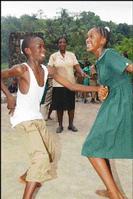
Students of the Moore Town Primary and Junior High School in Portland rehearse dance routines in front of National Heroine Nanny's monument in preparation for the annual Heroes Day celebration last October. In the background, a teacher at the school, Joyce Phillips, looks on. - File
THE MUSICAL heritage of the Moore Town Maroons in Portland has received international recognition in the form of a 'Proclamation of Masterpieces of the Oral and Intangible Heritage of Humanity', awarded by the United Nations Educational, Scientific and Cultural Organization (UNESCO).
Jamaica is one of 28 countries awarded the honour, and the presentation ceremony for the handing-over of the original proclamation will be held at the Institute of Jamaica (IOJ) in downtown Kingston on June 9, starting at 11:00 a.m.
The 'Proclamation of Masterpieces of the Oral and Intangible Heritage of Humanity' is an international distinction created by UNESCO in 1998 to "honour the most remarkable examples of the oral and intangible heritage of humanity."
RITUALS
The music of the Moore Town Maroons is considered an example of an oral and intangible cultural heritage, which has been passed from generation to generation and modified by a process of collective recreation. It bore much significance especially during slavery where work songs were used to ease the labour burden and to communicate secretly in fighting British soldiers.
This traditional music form of the Maroons is fundamental in the presentation and articulation of all aspects of Maroon life including rituals, celebrations and daily activities. The singing styles range from a nasal tone for outdoor singing required for carrying over long distances, to soft and guttural sounds for communicating within small groups.
In response to the award, Colonel Wallace Sterling of Moore Town stated that "We are quite grateful that our efforts at maintaining the musical legacy and by extension certain parts of language and dance of our fore parents, have been given the recognition it rightly deserves."
He further stated that the proclamation would give impetus to the Maroons as a people and would assist in highlighting their culture and making it more acceptable to non-maroons.
The proclamation encourages governments, non-governmental organisations (NGOs) and local communities to identify, safeguard, revitalise and promote their oral and intangible cultural heritage. It also aims to encourage individuals, groups, institutions and organisations to contribute to the management, preservation, protection and promotion of this heritage.
In a special ceremony held in November 2003, the Director-General of UNESCO, Koichiro Matsuura, declared that a total of 28 cultural spaces or forms of traditional and popular expressions across the world were outstanding examples of the intangible cultural heritage of humanity.
The Maroon music was identified as one such "cultural expression of outstanding value".
Other cultural spaces that were similarly recognised included the oral traditions of the Aka Pygmies of Central Africa, the Pansori epic chant of the Republic of Korea and the Kihnu Cultural Space of Estonia.
The submission of the candidature file for the Moore Town music to UNESCO was co-ordinated by the African Caribbean Institute of Jamaica (ACIJ), a division of the IOJ, and sent through the Jamaica National Commission for UNESCO.


















