By Mel Cooke, Freelance Writer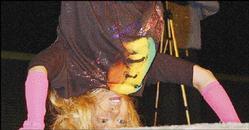
Junko Bashment
WESTERN BUREAU:
BEFORE THE movie with Audrey Reid and Paul Campbell, before the song with Chevelle Franklyn and Beenie Man, Brian 'Big Head' Martin was organising monthly dance contests in and around Montego Bay.
Just how much growth has taken place in the seven years since the first 'Dancehall Queen' was crowned is underlined by an addition to the name of the annual event, the first word.
This year's event is the 'International Dancehall Queen Competition 2003', to be held at Pier 1 in the St. James capital on Saturday, August 2.
The event was launched in classy but down-to-earth fashion at The Garage in Montego Bay, St. James, on Wednesday evening.
The international nature of the contest was underscored by the smiling presence of last year's winner, Japanese lady 'Junko Bashment', as well as the slate of contenders for this year's crown.
Dancers from Japan, the Bahamas, Canada, the United States (U.S.) and England will be going 'style for style' and 'wine for wine' against persons from Jamaica, including some from the contest's home city Montego Bay.
Brian 'Big Head' Martin, the managing director of Big Head Productions, which stages the Dancehall Queen events, was happy about the growth, some of which were indicated in a brief video presentation that covered the contest's history.
"At no time could I have imagined the event that started as a 'once a month' community dance competition would have grown this big," he said.
THE PRIZES
'This big' referred not only to the attendance, with a whopping 10,000 persons coming to see the ladies compete, but also the prizes. The International Dancehall Queen Competition 2003 will take home $100,000 courtesy of Slam condoms, a trophy and exposure for one year, with the second place winner taking home $40,000 and a trophy courtesy of Grand Central Cambio.
Big Head Promotions has put up the third place prize of $30,000.
However, the winner will also have several opportunities to travel and earn. Pointing out that Dancehall Queen 2002 Junko Bashment has since performed twice in Barbados and the Bahamas and also journeyed to the United States, Mr. Martin said, "The Dancehall Queens are in demand to appear on international shows with reggae acts and they are now getting a greater response than even sound system operators."
He emphasised that the Dancehall Queen contest is not simply a 'wine up'.
"People have always misunderstood the Dancehall Queen competitors. They are mistaken to be go-go dancers, but this is not so. These are women who make a strong fashion statement, women who are talented, with exceptional dance moves," he said.
Strong fashion statements were among the persons who gathered in The Garage to help get the contest underway, with the identically-clothed Slam Condom girls giving a picturesque plug for the company.
Red Label Wine's brand manager, Jomo Cato, expressed the company's sponsorship commitment by saying that "Red Label has used its association with dancehall to build the brand."
"Dancehall Queen, if properly packaged, can be one of the biggest exports out of Montego Bay and Jamaica," he said, looking forward to even more growth in the future.
LARGER CONTEXT
Guest speaker at the launch, Clyde McKenzie, put International Dancehall Queen 2003 into the larger context of packaging and selling Jamaican culture. "Dancehall is a very visual thing. If you look at 'Ponytail' (who dances in Sean Paul's Gimme The Light video), how she has created the visuals, you will see what I mean," he said. "We need to support people like Big Head, because what they are selling is Jamaican culture," Mr. McKenzie said.
"If Jamaica is serious about getting rich, Jamaica needs to get serious about its culture," he said to strong applause.
Mr. McKenzie took the attentive listeners along the timeline of dancehall music's exposure in the mainstream U.S. "Dancehall languished in obscurity for a number of years. In the early 1990s, almost every Jamaican artiste, his dog and his cat were signed to a major U.S. label," he said as the audience chuckled. They sobered up as he related how they were all dropped at about the same time, with socialisation, lack of management skills and 'slackness' in the music being blamed.
Pointing to the resurgence in the U.S., Mr. McKenzie pinned the current success on one factor. "The difference between 1993 and 2003 is that this time dancehall is being played on mainstream U.S. radio on its own merit. That is the crucial difference," he said.
Previously, "In the days of Shabba and those other acts, they had to make artistic compromises. They had to water down the music to get mainstream attention. What you had was a music that pleased nobody at all. Dancehall did not get a try. They tried something different and the market rejected it," Mr. McKenzie said.
The three-man strong Xsytement Gang gave a harmonious and deejay view of not trusting their best friend around their girlfriend in bringing entertainment to the launch of International Dancehall Queen 2003.