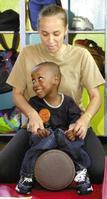
Therapist Andrea Cameron with little Keval. HER LIMBS are as slim as twigs, but little Ashley only needs a little more confidence to walk. She clutches her care-giver at the School for Therapy, Education and Parenting (STEP) centre with determination, refusing to let go.
"She is very coward, afraid to walk by herself," says the care-giver, teaching assistant Junetta Chen.
This is Ashley today, but maybe one day soon, she will develop the courage and her underdeveloped legs will grow strong and sturdy as any other child's.
Ashley will walk one day, but her case is one of the simpler ones at STEP, located at St Margaret's Church Hall in Liguanea, Kingston.
At the centre, for 17 other students who suffer from cerebral palsy, Down's Syndrome and other disabling conditions, the prognosis is more challenging.
Therapist Andrea Cameron notes that for every one of the minors, their nervous system has been damaged, so their ability to move has been impaired. It is up to parents, through therapy, to help them to achieve normal sitting and standing positions.
"Some will walk. Others will never be able to, while still others will be able to move about with adaptive aids such as walkers," the therapist notes.
The children, as a consequence of nerve damage and a lack of muscular control, also have problems with eating and speech.
"Anything that relates to the use of muscles will need therapy," Cameron states, noting that even vision can be affected, because they are not able to focus properly.
The advice to parents -- to get their children into therapy at an early age -- is, however, easier said than done. As Cameron herself notes, for children with severe disabilities, there are very few facilities which will accept them, as most places demand that the children be able to help themselves (self-feeding, walking) before they are taken in. There is also the matter of cost. It costs money to run programmes like STEP and to get therapy, for example, it costs $24,000 per child per term and that is subsidised. Also, such devices as a walker which enhances mobility, costs US$5,000 each. Not many parents will be able to afford this.
STEP was created by parents of children with multiple disabilities, who had no alternatives for child care. Ten years ago, they set up at St. Margaret's, the subsidised programme which now provides cognitive and physical training to minors, teaching them self-help and social skills as well.