By Erica James-King, Staff Reporter 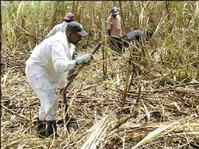
Cane cutters on Frome Estate in Westmoreland, work feverishly at their jobs in the field. - Ian Alen/Staff Photographer
THE ALREADY troubled sugar industry is in for another sound beating, as sugar estates islandwide are reeling from a chronic shortage of cane cutters.
The shortage has resulted in the intermittent closure of factories and at least three of them stand to lose more than $3 million a day combined, for every day that the factories remain idle.
The problem is limiting the earning potential of the sector as well as creating millions of dollars in wastage of fuel, productivity and production time.
The acute shortage of cane cutters has sent public and privately-owned sugar estates scrambling to implement emergency recruitment drives, but these recruitment programmes have yielded only minuscule results a far cry from answering the prayers of sector interests.
"For each 24-hours that a factory is out of cane owing to harvesting problems created by the lack of cane cutters, the industry stands to lose millions," Livingston Morrison, chief executive officer of the Sugar Company of Jamaica (which oversees Government-run sugar entities), told The Sunday Gleaner.
He believes the scarcity of cutters has disrupted the sugar production process so much that it has led to frequent time lapses at individual factories, factory shut downs and delays in sugar manufacturing at all factories during this crop.
"While the factory lies idle, employees still have to be paid, our output is affected we are not putting out as much as we can and it demands more fuel to start up the boilers and mills once they are shut down completely," Mr. Morrison stated, in outlining the magnitude of the cane-cutter problem. "So, each 24-hour that Frome is shut down, at least $1 million is lost by the factory. For each hour that Monymusk is shut down, $1/2 million goes down the drain and for each hour that Bernard Lodge is shut down the loss could amount to $600,000."
The Sugar Company of Jamaica (SCJ) which controls five of the seven sugar factories across the country, sees the difficulty in procuring cane cutters as the greatest manpower void to have hit the sugar industry, in its modern history.
"There is just a serious, serious shortage of cane-cutters. It's the worst it has ever been in the industry," disclosed the SCJ CEO. The cane-cutter woes come amidst other problems in the sector including heavy indebtedness by some estates, inefficiency, inadequate financing for replanting programmes, lack of collateral by small farmers to access financing and lower rates for sugar being received on the EU market.
Frome Sugar Estate in Westmoreland, the largest sugarcane farm in the English- speaking Caribbean has been one of the sugar entities worst affected by the shortage of field workers, whose purpose is to cut cane.
The factory is in tip-top shape to grind up to 5,000 tonnes of cane per day, but is nonetheless plagued with work-stoppages, due to the shortage of canes, triggered by delays in harvesting both on the 4,600 acre lands owned by Frome and that of the small farmers supplying the factory.
And the shortage of cane cutters couldn't have come at a worst time-the factory is having problems with some of its four mechanical harvesters. "We have had quite a bit of break-down on the harvester side though in the field...The chopper harvesters are now just over 10 years old, so one can understand the situation there," Victor Drum, co-chairman of the Frome Harvesting Committee, stated.