By Sana Rose, Contributor 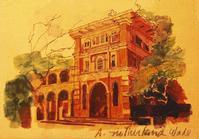
St. George’s College
TITLED "JAMAICA Revisited", the solo display of paintings
by artist Heather Sutherland Wade opened at Bolivar Gallery on March 26.
The show is a collection of miniature and medium scaled works depicting the old architecture, landscape and flora of Jamaica. Sutherland Wade's signature style of painting forms in blocks of colour is pervasive throughout the landscape and flora studies combined with glazing and spattering while, in the architectural studies, she opts for pen and ink line drawings and acrylic washes. Within the thematic groups, she adds light texture created by materials such as sand, paper and cloth to infuse tactile sensibility in the works.
The miniature scaled architectural studies of old public buildings appear as photo album images as though the artist wishes to preserve the memory and historical significance of her subjects. The images are first done on paper, which is then torn to follow the irregular shapes of the image and mounted in the centre of the canvases. The results are images that give the effect of sketches or illustrations floating within the format of the canvases. Favouring two or three-point perspective, she adds the surrounding foliage and washes of colour.
The images are not necessarily "fresh" like on-site studies but slightly more calculated in their renditions. However, the artist adds a personal sketchbook touch with the notes she makes in the images. Among the historical sites are the East Street Moravian, Port Royal Anglican and Coke Methodist Churches, the Hampton and Westwood high schools, the Immaculate Convent and the Morant Bay court house.
Sutherland Wade's application of paint in the larger works is like building blocks of colour reminiscent of the French Post-Impressionist painter, Paul Cezanne in his mature years in the late nineteenth century. Cezanne's paintings of this period manifest a kind of abstract handling of volume where his images are built up with blocks of colour.
From the Jamaican pool, Sutherland Wade's technique finds kinship with the semi-abstract renditions of George Rodney and the structurally rigid forms of Barrington Watson. Like these artists, Sutherland Wade's forms are architecturally stable and she allows us to see the skeleton of the painting as she leaves the drawing lines visible. The landscapes and seascapes and some of the flower pieces exemplify this approach and is most evident in pieces such as 'As Time Passes', 'The Mote, Bog Walk', 'Saturday Afternoon, St. Ann's Bay', 'Rushing Calm' and 'Restless'.
The most interesting thing about Sutherland Wade's technique is the push and pull of shapes and planes in her compositions. She flattens parts of the scenes and leaves focal points such as trees and boats more three-dimensional. The pieces are almost abstract but she gives us just enough information to keep us in the realm of representation. Should she continue to break down and build up her paintings with these blocks of colour, the forms would dissipate into abstract vistas in her chosen colour scheme of predominantly blues, greens, warm oranges with touches of red.
Sutherland Wade is not necessarily concerned with light but rather form and colour. Her structural approach to image-making may well be influenced by her graphic designing background. The most successful aspect of the show is the pieces, which make the most of her abstract approach to volume. By obscuring parts of the image the pieces meander between two and three-dimensions creating a visually attractive interplay in the images, which could be amplified and developed in future works. She has not attached any deep emotional content to the work but rather indicated her interest in the formal aspects of her subjects with touches of experimentation.
However as a landscape artist she says, "My 'gift of art' enhances my view and concepts of landscapes and horizons-and with the absence of self-occupation, delight in God's creation". The artist's view we see is the man-made and the natural coexisting in an almost abstract mindscape. "Jamaica Revisited" continues until April 9.


















