File
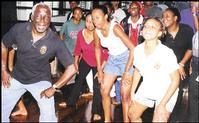
University Singers in rehearsalIn every nook and cranny of Jamaica there are church choirs and singing groups dedicated to bringing joy, through music, to all.
The University Singers, Mona, which began in 1958 with a handful of singers, maybe about 10, is one such group dedicated to bringing joy through music. However the University singers, now with a membership of between 30 and 35 singers, a colourful repertoire, electronic accompanying instruments and a wardrobe which represents a diverse cultural spread, was quite different 20 years ago.
"I developed a format in concert programming which carried variety traditional anthems, spirituals, gospel, negro spirituals, popular songs and songs from the shows. The inclusion of popular songs is really to show that songs by Bob Marley, Peter Tosh, Jimmy Cliff and Luciano, among others, can be presented chorally in a rich tasteful manner. I introduced a movement component and developed a new style of presentation in which the visual became as important as the music - really a type of choral theatre", Noel Dexter, musical director of the group, explained.
Marjorie Bayley, past director and pianist, recalls when she was asked in 1960 to lead the group. " I knew very little about choral singing then and, even more alarming, directing a choir. I had just left Knox College, Spaldings, Clarendon, quite inexperienced, although I had music lessons and was quite proficient in playing the piano. I took over the group at the time when the late Tom Murray was head of the Music Unit on the Mona Campus. And he willingly coached me on choral singing and how to run the group", she recalled.
"The group was a small one, about 12 in number", she remembered. "We walked, talked and slept music. Our repertoire then was mainly classical (religious songs), madrigals and English folk songs. Our first major appearance on campus was to perform for Princess Alice, Chancellor of the University at that time. We were asked by Professor Nettleford to perform some African folk songs." The Sunday Gleaner asked the professor about African songs at that time and he responded: "I wanted them to expand their repertoire, which was mainly classical music. And I had used a set of songs I used in a dance work called African Scenario."
Yvonne Laughton-Sobers, a a foundation member of the University Singers, recalled when she became a member in 1958. "I was in a period when the choir had no formal structure. We did mostly a cappella singing. It was more a leisure time activity. We sang on our way back from classes to the Union. We performed at campus events and carol service at Christmas time. We also fulfilled engagements on the north coast," she said. She also explained that the choir's repertoire was mainly classical music and the sound that was produced could be likened to that of Kings College Chapel Choir, England. The choir, she further explained, was not a concert choir, hence they were engaged in ad hoc performances on campus.
From 1970 78, Lileth Nelson co-directed the choir for three years, along with Dr. Patricia Webbly-Bethune. Miss Nelson took the choir when it needed to be rebuilt. She also led the group of singers at a time in our history when identification with things Jamaican was being encouraged by the government of the day. "We were exhorted to be self-reliant. It was also a period in history when the choir took on new proportions. Apart from performing classical, gospel, folk and madrigals, we began experimenting with our folk forms. And, to encourage song writing by our members, Verena Reckord wrote the lyrics for the song Love Is The Thing and music was composed by Cedric Brooks. During those years too, we worked with the Mystic Revelation of Rastafari and performed pieces such as Bungo Man A Cum, Rivers Of Babylon and Peace And Love," she said. Accompaniment was provided by Sam Clayton and Cedric Brooks.
According to Ms Nelson, it was the first time in the history of the University that the singers performed Rasta songs and were accompanied by Rastafarian musicians. She also pointed out that it was during her eight year stint as director that experimentation with folk forms of the Caribbean began. Her repertoire at that time also included 'play songs'. "This period was a very dynamic one for the group and the university in general. We made a big shift to diversification and expanded on our repertoire . Another of our very strong point was our ability to sing spirituals," Ms. Nelson said.
Undergraduates were admitted to the group by way of auditions. This was not the main criterion for director Marjorie Bayley. "Ability to read music was a must and also compatibility. Music scores were unavailable then and we took turns to write music scores. Also, when we sing, only a tuning fork was used for pitch," she said. However, the main requirement for Ms Laughton-Sobers to enter the choir was "it was mainly for people with genuine interest those who want to sing and take music seriously."
At present, entry to the choir is through audition. "We have to audition people so as to keep the numbers down. This is to facilitate easy travel", Mr. Dexter said.
The University Singers began extensive travels during the late 70s, not only for concerts but for research and experimentation. "We travel overseas to get background information on cultural forms. Our concerts were arranged accordingly. Our performances were based on knowledge of works done," Miss Nelson told The Sunday Gleaner.
At present travel overseas is based mainly on invitation. Mr. Dexter explained that travel for the singers now include travel to the Caribbean islands, England, the USA and Canada.
While the University Singers continue to experience significant development in functioning as a singing group.
The standard remains intact.