File
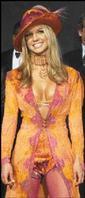
Britney SpearsTanya Batson, Staff Reporter
Girls! Girls! Girls! is the famous yell by hard rockers Motley Crew. It is a theme that is not only understood, but is also celebrated by Jamaica's dancehall culture. Beenie Man's Nuff Gyal and Shabba's Trailer Load are just two of the more popular anthems on this theme.
But it is not only in songs that the female body is cast about. Naked, topless, and technically unclad, they are strewn across magazines, tabloids, music videos, condom packages and almost anywhere else one can think of. The question is, however, what is the big deal? Does this kind of use (or some would think abuse) of the female form in the different areas of entertainment have any effect on ordinary women in society?
The truth is that in entertainment, women are a valuable commodity. Deejays, rappers and rockers all trade in female sexuality to help to affirm their heterosexuality. This is even more important in Jamaica, due to the level of homophobia in the society.
Nowhere is this more evident currently than in the name calling that has begun since the appearance of the No Doubt video for the song Hey Baby, which features Bounty Killer. All the noise is being made because the band's drummer, Adrian Young, appears in the video naked. While this may not appear as a surprise to No Doubt fans, as he is usually either naked or next to it, aspersions have been cast on Bounty Killer's sexuality, although he and Mr. Young do not appear together in the video.
But the matter does not simply rest with how women are portrayed in male videos or on magazine covers. Also important to the issue, is how many female artistes also portray themselves, or are marketed. With the arrival of the Spice Girls, there was a lot of talk about 'girl power'. However, for many women bent on claiming their power, the Spice Girls and those of their ilk are do not have sufficient 'Grrowl Power', according to Jennifer Pozner in her article 'Makes Me Wanna Grrowl'. She points out that "the revolution, when it comes, will not be sparked by a Wonderbra."
Rather than depicting female power, the Spice Girls represent male fantasy, calling to mind Eminem line "I can't figure out which Spice Girl I wanna impregnate". Of course, not only the Spice Girls are in this category. Britney Spears also appears to be one of these complicit figures. The argument could actually be made that she has risen to stardom on the power of her abs, which are almost always in evidence when she is performing.
The argument that is held against such portrayals is the effect they can have in shaping the behaviour of young women. Mrs. Beryl Weir, the Acting Director for the Women's Centre of Jamaica Foundation, points out that what she has observed in the girls under her care suggests that the portrayal of women in the media does have an effect. "I think that sometimes, or most times, what we see in the media, for example the 'Hottie Hottie' where girls receive a prize to dress like that, it sends a negative message." She points out, however, that young people with self-esteem and very good value systems may choose to do the opposite of what these images suggest.
In a paper titled 'Gender as a Dynamic Concept in the Media', Hilary Nicholson questions the portrayal of women in the media and its effects on how women are therefore perceived. The paper implies that the constant portrayal of body parts leads to the viewing of women as objects, as they are devoid of personality and feeling. She also remarks that the media is very effective in shaping notions of acceptable gender behaviour. Ms. Nicholson says that the media often targets women, telling them how to behave and how they should look.
Interestingly, it is with this view in mind that Dr. Carolyn Cooper embraces dancehall culture and the portrayal of women therein. Dr. Cooper has publicly stated that she endorses Shabba's use of slackness in songs such as Caan Done, because of the sexual freedom accorded to women therein. "Dancehall is a space in which particularly African Jamaican women can celebrate their bodies," she says. Dr. Cooper's argument is that in many other spheres, for example the fashion or beauty pageant, the fat black woman's looks are rejected. She points out, however, that some videos seem to contradict this, as they often feature only skinny brown women. According to Dr. Cooper, Carlene, who had been dubbed the Dancehall Queen, represents the "fusion of the ideal body." She is a combination of large thighs and bottom, a pretty face, and she is also light-skinned.
Lecturer June Castello at the Gender Studies Department at the University of the West Indies argues that the effect of female portrayal is dependent on what it says about women. "Essentially, what does it mean?" she asks. Ms. Castello further pointed out that every action has a symbolic meaning, which is what is truly important. Thus, the important thing isn't the portrayal of the female body, but what said portrayal suggests or means. Ms. Evelyn Scott at Women's Media Watch pointed out that it is a part of Women's Media Watch's goal to sensitise women to these portrayals. She remarks: "It don't look good on women. It don't look good in the eyes of the public, but some people will say see nothing wrong with it."
That appears to be the crux of the matter. While some members of society are okay with these portrayals, others find them to be offensive.