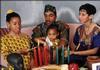
- ContributedThis African-American family is taking part in mishumaa, the practice of lighting one candle on each day of Kwanzaa, a holiday celebrated yearly December 26 - January 1.
Claude Wilson, Freelance Writer
Western Bureau-
FROM December 26 to January 1 many African-Americans, and Jamaicans too, will celebrate Kwanzaa, a festival derived from African harvest celebrations which originated with African-American activist Dr. Maulana Karenga in 1966.
Before he left office, President Bill Clinton validated the celebration when he said "Kwanzaa focuses on the values that have sustained African-Americans through the centuries". But according to an American Christian magazine, commentators seized on the President's statements, mocking him for supporting this recently manufactured holiday.
According to the magazine, popular American columnist, Ann Coulter, called it a "synthetic holiday".
Yet while Coulter and others mock Kwanzaa's "synthetic" origins, many do not realise that Christmas is just as synthetic as is Kwanzaa.
Religious scholars acknowledge that Jesus Christ was not born on December 25. Neither Christ nor the Apostles celebrated his birth and, for generations afterwards, his birth was neither known precisely to nor celebrated by the early church.
The Encyclopaedia Britannica states that church fathers of the second and third centuries, contended that Christmas was a copy of a pagan celebration. "Only in the fourth century AD did professing Christians throughout the Roman Empire set aside December 25".
Despite the knowledge that this holiday is of pagan origin that was formalised in the western Christian world, the established churches continue to keep Christmas (mass of Christ) as the birthday of Christ and as a central religious holy day.
The pagan Saturnalia, Brumalia and later the Mithraic feast, the latter two celebrations occurred on December 25, have had all the cultural similarity of today's Christmas celebrations. Our Christmas worship, being adopted from pre-Christian celebrations, is therefore a striking example of what God says His people should not do.
The holly and mistletoe, sacred in pagan festival, Yule Log, the pagan symbol of the sun, the Christmas exchange of gifts, the Madonna and Mother and Child theme (Silent Night, Holy Night) are all relics of pre-Christian times.
Yes, some say they used it to honour Jesus Christ but why use an old pagan sun-worshipping festival to honour our Saviour. When we take the worship of the heathen god and attach Jesus' name to it, can He be pleased, isn't this unfaithfulness, and hasn't He got feelings too?
The church, like ancient Israel, is an unfaithful partner in the spiritual relationship with Christ. When preachers tell congregations that the law of God, the ten commandments are done away with and therefore Christians are no longer bound to keep the Creator's laws, which even Jesus himself kept and told others to keep (Matt. 19: 17), can God be pleased with the church?
Jesus is not the real benefactor of our Christmas tradition, rather it is the merchants many of whom do not believe that Jesus Christ is the Son of God. We need to get rid of the pagan traditions and get back to the teachings of the Bible and see if God does not incline His ears towards us and heal our land.
Finally, as a secular holiday, the principle of Kwanzaa that celebrates family, community, and culture are perhaps what people of African descent should observe rather than attaching religious significance to European pagan culture.
More on Kwanzaa next week