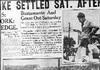
- FileA clipping from a May 30, 1938 Gleaner newspaper, showing news about the granting of bail to Alexander Bustamante, and of marches and disturbances surrounding the 1938 labour uprisings.
Louis Marriott, Contributor
This is the tenth in a series of articles reliving the years up to Independence by a journalist/ broadcaster whose childhood and maturation coincided with Jamaica's.
THE sharp differences between Daddy and Uncle Horace, which was a regular feature of Uncle Horace's Sunday visits in the problem-filled months of May to July 1938, returned to the fore as labour disturbances again racked Jamaica in January 1939.
The bone of contention was, as always, Alexander Busta-mante. Daddy found the labour leader's "dictatorial style unpalatable". He reminded Uncle Horace that the members of the Moyne Commission were obviously unhappy about the naming of a trade union after its leader. "Nowhere else in the world," Daddy told Uncle Horace, was a union named after its leader.
In the second half of January 1939, word got around that the flagship Bustamante union, now the Bustamante Industrial Trade Union (BITU), had been newly registered, that its rules specified that Bustamante was its president for life and that most of the senior executives of the union would be appointed by Bustamante rather than elected. "The man owns the union," Daddy told Uncle Horace, again adding that this was a global first. Uncle Horace retorted that we should be proud that Jamaica was ahead of the rest of the world.
According to Daddy, the Governor, Sir Arthur Richards, whom the Colonial Office in London had clearly handpicked to control Bustamante, was also uncomfortable with Busta-mante's autocratic control of the union. Efforts to persuade Bustamante to democratise the BITU and its seven satellite unions and to drop his name from the umbrella union fell on stony ground.
TRUCE ENDS
In February, the truce between Bustamante and A.G.S. Coombs, engineered by Sir Walter Citrine of the Moyne Commission, ended abruptly. St William Grant, mysteriously recalled to Bustamante's service, was dispatched to Mon-tego Bay in furtherance of a challenge to Coombs' union stronghold in that town. Following a scuffle between Grant and one of Coombs' activists, Bustamante and Grant demanded an apology. With no apology forthcoming, they then demanded the Coombs supporter's dismissal by his employers, the United Fruit Company (Unifruitco).
Unifruitco were caught between the Scylla of a threat by Coombs to lock down the port of Montego Bay if the worker was dismissed and the Charybdis of an islandwide general strike, threatened by Bustamante, if he was not. No doubt emboldened by a belief that Richards could contain the latter threat, and motivated by their stake in the port of Montego Bay, the banana-exporting Unifruitco refused to dismiss the worker.
BUSTA CALLS A STRIKE
Bustamante called the general strike on February 13. The following day, Richards declared a State of Emergency. On February 16, the Governor told members of the Legislative Council:
"I find it difficult to appreciate why the sugar estates of St. Thomas and the trade of Kingston and Port Antonio should be sacrificed because of a personal quarrel in Montego Bay, for which the law provides a remedy in court."
Describing the general strike as a threat to the entire population and "an attempt to hold the community to ransom", he declared that the Government had a duty to ensure that essential services were carried on and not permit the life of the community to be endangered by "the irresponsible will of a few men". He insisted: "There can be no settlement and no peace until orders for a general strike are unconditionally withdrawn."
Bustamante's strike call was met by only half-hearted support and Richards rattled his sabre, hinting repeatedly that the labour leader would be arrested if he did not end the strike.
On February 17, Norman Manley convened a meeting attended by Bustamante, Ken Hill and several other trade unionists as well as Wilfred Domingo of the Jamaica Progressive League of New York. Manley proposed the formation of a Trade Union Advisory Council (TUAC), similar to the (British) Trades Union Congress. It was an idea floated by Citrine when the Moyne Commission visited. All the trade unionists in attendance, including Bustamante, agreed to affiliate their unions with the TUAC. Manley advised Richards accordingly, the general strike was called off, and the State of Emergency was lifted.
HANDSHAKE OF CHANGE?
At the first meeting of the TUAC, at Manley's law office on Duke Street, Bustamante and Coombs shook hands, a gesture they repeated at a monster rally at Kingston Race Course on February 25. The rally was held under the banner of the five-month old People's National Party (PNP), of which both Bustamante and Coombs were foundation members.
All Jamaica welcomed the Bustamante-Coombs rapprochement and the unification of the labour movement. Two months later, however, Bustamante repudiated the umbrella body, now renamed the Trade Union Council (no 'Advisory') under the chairmanship of PNP Vice-President, Noel 'Crab' Nethersole, and secretaryship of Florizel Glasspole.
The BITU suffered some fallout from these events in loss of membership and splintering into new unions. Most notable perhaps was Ken Hill's resignation from the vice presidency of the Transport Section of the BITU to form the Tramway, Transport & General Workers Union.
Although the BITU and its satellites remained dominant among the labour force, the combined strength of all the other unions in the TUC was a significant alternative and a potential threat to Bustamante's monopoly control of the working class movement.
Daddy constantly nettled Uncle Horace with talk of Bustamante's "dictatorship" and capriciousness. But, like a batsman who has bottled up his shots in the determination not to lose his wicket, Uncle Horace stonewalled stubbornly and stoically. He reminded Daddy that when the workers needed a leader it was Bustamante that stepped forward. There were others who now claimed to represent workers whom he described as johnnies-come-lately.
PREPARING FOR CHRISTMAS
Meanwhile, on the home front, we children continued growing physically, I more slowly than the others, while the family grew in number. Lloyd was obviously enjoying life as a student at Greenwich Farm Elementary School. Some of his new friends who passed our gate on their way home would pause, especially during the coolie plum season, when they feasted under the tree in our yard. Mama discouraged their hanging around. After ensuring that they got their quota of plums, she hastened them off to the bosoms of their own families.
Daddy continued churning out ice cream on Sundays, surrounding the stainless steel cylinder with coarse (unrefined) salt and chipped ice. Inside the cylinder was a delicious mixture that Mama prepared. She rang the changes: soursop, pineapple, cherry, strawberry, chocolate, vanilla, grapenut, even rum and raisin.
As Christmas neared, all the trauma of the year "accidentally scalding my cousin Rema with piping hot banana porridge, receiving a memorable flogging for kicking my sister Norma, and being long confined indoors by foul weather" was forgotten. Not even dire predictions of hardship resulting from the war in Europe destroyed the Yule spirit.
The advent of the season was, as usual, heralded by the cool and balmy 'Christmas breeze'. Carols were played on the old gramophone that was wound up by a jack and spun the turntable until the winding ran out, at which time the technological marvel slowed down, degenerated into a discordant wow and stopped dead.
There was great excitement all round as the big day approached. Daddy brought home a branch of a lignum vitae tree on his bicycle, potted it, stripped off its leaves and painted the skeleton of the branch with white gloss. Mama then took over the Christmas tree. She dressed it with white cottonwool, representing snow, and with assorted tinsel. Daddy set about whitewashing the bases of all the trees in our yard and our grandparents'. Everyone laughed when I remarked that the trees were wearing white socks.
Daddy painted part of the house too. All our neighbours seemed also to be painting. Trees and shrubs were pruned, the yard swept like never before. Santa Claus would be impressed.
We burst clappers and thunderbolts and watched the 'starlights' sparkle with breath-taking awe. Long-lost relatives visited. Fruits abounded. We went downtown, browsed through the prestigious shops of the Issas and Hannas, and each of us came away with a pair of shoes which was kept in its box until the big day.
A sour note was struck when I was excluded from a young family party that joined the King Street revellers on Christmas Eve. Mammy persuaded her daughters who were in charge of the group that I should be left behind because I was too rude.
After the morning church service, the egg nog, the sorrel drink, the ice cream and the rich fruit cake, in the evening we staged a Nativity play we had been rehearsing for weeks. Daddy converted the front yard into a theatre. Mama made the costumes. The actresses' skirts were rustling crepe paper from Times Store. At four years old, I was one of the three wise men.
Louis Marriott is a journalist and broadcaster, a former BBC radio producer/presenter and Press Secretary to the Prime Minister of Jamaica.