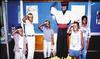
- ContributedThese youngsters are having fun as they salute the "Police" Jonkunoo character, which is part of the Institute of Jamaica's "Run, Run, Jonkunoo A Come" exhibition being staged in downtown Kingston.
Georgia Hemmings, Staff Reporter
IT IS, perhaps, fitting and timely that an exhibition on our Jonkunoo tradition should be hosted by the Institute of Jamaica (IOJ) around this festive season.
After all, Jonkunoo (also referred to as John Canoe, Jonkanoo, and John Connu) was an important highlight of Christmas past. It can be traced back to the "free" time given to slaves during the holidays, and the tradition of Jonkunoo masquerades occurred between Christmas and New Year as slaves celebrated with dances and festivals.
The "Run Run, Jonkunoo A Come" exhibition now on at the IOJ's exhibition hall in downtown Kingston is primarily an educational one, designed to generate interest and appreciation in this aspect of Jamaican culture, its development and changes over the years.
And staging such an exhibition is in keeping with the Institute's mandate of encouraging greater cultural and artistic knowledge among Jamaicans.
The format of the exhibition certainly lends itself to information dissemination. Artefacts, still images, life-sized figures in Jonkunoo costumes, musical instruments, paintings, prints, and a video presentation are all combined to give total understanding.
And the exhibition is presented in chronological order, beginning with the African origins of the Jonkunoo practice and early Jonkunoo celebration within the plantation community.
Then it is on to post-Emancipation celebrations, and a look at Jonkunoo today and its place in contemporary culture. The exhibition makes it clear that today there is less public support for the Jonkunoo tradition.
In fact, although Jamaica is credited with the longest running tradition of Jonkunoo, today these mysterious bands with their gigantic costumes appear more as entertainment than as a vibrant part of our culture. Certainly, the eventual disappearance of Jonkunoo will mean the loss of one of the island's most enduring elements of African heritage.
For now, "Run Run, Jonkunoo A Come" gives viewers the opportunity to be updated about the dress and pageantry of this folk form.
Traditional Jonkunoo characters are presented, splendidly attired, and spaciously positioned in dramatic performance poses.
"Cow Head" greets the viewer as he/she enters the room, garbed in colourful calico cloth and a mask from which the cow horns extend. This particular character represents the warriors and hunters of the West Africa communities from which it originated.
'Pitchy Patchy'
and the rest
Then there is "Pitchy Patchy", dressed in brightly coloured strips of shredded cloth, and wielding a whip. According to the text on the raised platform, this character recalls the bush and branch camouflage of the Maroon warrior, and signifies unpredictability and precariousness of life for slaves.
"Jack-Na-Green" echoes African vegetal costumes made from leaves and raffia. This untamed spirt shook and moved, changing directions unpredictably during performances. It also recalled Maroon camouflaged bush figures.
The "Devil" (brandishing a pitchfork), "Horse Head", "Duppy", "King", "Queen", "Actor Boy (Koo Koo)", "House Jonkunoo"(with a large image of a Great House on his head), and "Belly 'Ooman" are other integral figures of the Jonkunoo parade. There was also "Captain", "Warwick", "Champion", and later inclusions such as the uniformed "Sailor Boy" and "Police".
The textual information accompanying the figures is simple and specially geared to the target audience of students in the 11-16 age group. But it can also be appreciated by more mature minds.
Twelve prints by Isaac Medes Belisario, loaned by the National Library of Jamaica, highlight Emancipation-era Jonkunoo celebrations. And two paintings from the national collection of the National Galley of Jamaica (NGJ) present contrasting views and styles of expressions about Jonkunoo. The paintings are a semi-abstract by Osmond Watson and an intuitive piece by Gaston Tabois.
As Jonkunoo is a highly rhythmic form, information is also provided about the musical instruments associated with it - the fife, bass drum, rattle, grater and spoon, the jaw bone, conch shell and the Gombeh (a square-framed drum).
Four Guelede masks complete the exhibition, and, according to Wayne Modest, director of the Institute's Museums' Division, these are authentic African artefacts.
Mr. Modest told The Sunday Gleaner that the artefacts and figures in the exhibition were all arranged and put together by Jonkunoo groups across the islands.
He explained that the primary purpose of "Run, Run, Jonkunoo A Come" was to "enlighten youngsters in particular who have never been exposed to Jonkunoo traditions."
But, apart from bringing back memories of old-time Christmas activities, the show had provided an opportunity for the Institute to collect artefacts and make recordings for posterity.
"Through this exhibition, we will seek to initiate methods for the preservation of objects and documentary information associated with this folk form," Mr. Modest told The Sunday Gleaner.
Certainly, it might be important to learn more about this aspect of our past, for it maintains a powerful connection with our African spirituality.
And, as the exhibition points out, "...Jonkunoo speaks powerfully through its characters about the experiences, events and beliefs of the Jamaican people. It celebrates the deeds of our foreparents and heroes, and gives God thanks for guidance, prosperity, healing and protection."
For its educational value, "Run, Run, Jonkunoo A Come" should certainly be viewed by the Jamaican public, up to February 2002 when it ends. Perhaps the information could be captured in booklet form for the benefit of others.