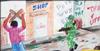
One of the entries which focused on the issue of crime and violence in the society.Georgia Hemmings, Staff Reporter
THE right to have a bed, to play, to write, to wear clothes, to have rainbow in one's lives, to have friends, to be loved, and to hear and be heard.
These are the thoughts from children about what is important in their lives and basic rights, human rights, as seen through the eyes of youth.
And this is the theme of an international travelling art exhibition currently on at the Junior Centre of the Institute of Jamaica (IOJ), located on East Street in Kingston.
The children's exhibition was brought to Jamaica by the Canadian High Commission, in collaboration with the IOJ.
Robert Richard, political and economic counsellor in the Canadian High Commission in Jamaica told The Sunday Gleaner that the show is designed to use art to teach children about human rights and how these rights can be promoted and maintained.
"Children are asked to use the medium of art to depict why everyone should be allowed freedom of expression as set out in the Universal Declaration of Human Rights," he said.
Now in its fourth year, he explained that the exhibition originated from a competition launched in 1997 by the National Arts Centre of Canada, in commemoration of the 50th anniversary of the Declaration of Human Rights.
Back then, the contest targeted children between 6-18 years, and, from the more than 700 works submitted, 50 pieces were selected to form an exhibition which toured museums and libraries in the Caribbean and Latin America.
The travelling exhibition began at the headquarters of the Organisation of American States (OAS) in Washington DC, and has travelled to 18 countries in the region, including Guatemala, Uruguay, El Salvador, Chile, Argentina, Barbados, Haiti, Peru, Brazil, the Dominican Republic, Venezuela, Mexico, and Guyana.
"In each host country, the exhibition has sought to target local youth," Mr. Richard explained.
In fact, a unique feature of the tour is that, on each stop, local children are invited to draw their own pictures about human rights, and the winning entries then become part of the tour throughout the region.
The Jamaican leg of the competition attracted 30 entries from students in primary and high schools, and the after-school facility at the Junior Centre.
Three winners were chosen in three categories -- 6-9 years, 10-13 years and 14-18 years - and these winning entries will be included in the travelling exhibition when it leaves Jamaica.
The Canadian High Commissioner, John Robinson, participated in the launch at the Junior Centre last Thursday, along with IOJ's chairman, Professor Barry Chevannes, and executive director, Vivian Crawford.
In his presentation, the High Commissioner pointed out that, since 1989, more than 180 countries have signed the Special Human Rights Convention for Children established by the United Nations.
"Yet children around the world still die from diseases that can easily be treated or immunised against, still have to work long hours instead of going to school or playing, and still are neglected, abused and exposed to violence and harmful drugs," he said.
Mr. Robinson commended the children for their entries, stating that "the pictures you have drawn will make a difference. By showing these pictures, you are telling others that abuse is wrong, that having to go to work instead of school is wrong, and that using harmful drugs is wrong."
Celestine Thomas, director of programmes at the Junior Centre, was enthusiastic about the initiative from the High Commission, and urged the public to view the exhibition.
"It is a wonderful idea to have children express their thoughts and their priorities, rather than an adult perspective." she said. "And it is in keeping with the Junior Centre's mandate of helping children develop their skills in various art forms for their intellectual, aesthetic, and cultural growth."
She expressed regret that, because of the short time frame, no submissions were received from rural schools.
However she promised that these schools "will not be overlooked in future collaborative efforts, and our own local competitions."
The travelling exhibition was due to arrive in Jamaica in September, the start of the academic year, but was delayed due to terrorist attacks in the United States and subsequent travelling difficulties.
On show are the original winners from Canada, as well as pieces from other countries and local submissions.
The works comprise a mix of drawings, paintings and watercolours, each accompanied by poignant messages about human rights.
"The right to have a bed", declares seven-year-old Sara, original grand prize winner in the 6-9 age group.
Eleven year old Lisa depicted people dancing in different poses: "They are expressing themselves by the way they dance. People should have the right to express themselves because everyone has the right to freedom. All the people in my picture are equal."
She was the overall winner in the 10-13 category, while 15-year-old Bojan was the grand prize winner in the 14-18 group.
For Bojan, human rights is about "dancing colours. Without the colours, everything would be the same....What makes life beautiful is diversity."
"Everybody has a right to have rainbow in their lives" declared six-year-old Elodie, while 11-year-old Colin believes that "colours do not matter. Nor your size. Your heart is what happens."
Other freedoms highlighted by the youngsters include the right to a safe environment, to have medical care, to be loved, to sing, to vote, to be treated fairly, to freely express, and be equal.
"We hope that many Jamaican children will have the opportunity to see the exhibition. And, as adults view it, they should have an open mind to the thoughts of children about what is important to them and how to protect people's rights around the world," Mr. Richard told The Sunday Gleaner.
"Human rights through the eyes of youth" is scheduled to end on Thursday, November 8, then the collection will return to Ottawa, Canada, to continue its journey on a new itinerary.
More information on the hemispheric exhibition can be obtained at www.dfait-maeci.gc.ca/youth-art/
Art reflects harsh reality
Images of dead bodies lying in the street, large pools of blood, political graffiti on walls, and the security forces engaging gunmen in battle dominated entries submitted by Jamaican school children for inclusion in an international art exhibition currently on show at the Institute of Jamaica Junior Centre in downtown Kingston.
The pictures revealed the frightening impact crime and violence is having on their lives, their concerns about safety, and testified that they had been witnesses of gruesome murders.
Titled "Human Rights Through the Eyes of Our Youth", the travelling exhibition seeks to highlight children's perspectives about human rights.
This is the Jamaican leg of the exhibition brought here by the Canadian High Commission. On each stop of the tour, local children are invited to draw their own images in keeping with the theme, and these are incorporated into the show.
The Jamaican images are in sharp contrast to other works displayed, which address issues relating to food, safety, freedom, education and equality.
Celestine Thomas, director of programmes at the Junior Centre told The Sunday Gleaner that the ideas presented by the children were enlightening.
"It was enlightening, sometimes frightening, to see the things that are of greatest concern to them -- issues such as safety on the streets, being safe from violence, even the right to wear clothes." she said. "The images are rather telling in their depiction about what's happening in our children's lives, and provide some guidance about areas where help (emotional, physical and social) might be needed most."
The entrants, from Corporate Area primary and high schools, highlighted the need to have home and family, freedom of movement (especially for the disabled) and safety from violence and other dangers.
"The cars are passing and the child is crossing the street. We have a right to cross the road," said one entry, while another stated "Children have a right to play in their community without being punished and shouted at."
Winners expressed more optimistic desires.
Camille Parker, winner in the 6-9 age group, spoke of a youngster's right to "play safely in a place where it is quiet and peaceful."
Shane Frank, winner in the 10-13 age group, addressed the need for "clean air to breathe", while Monique Thompson, winner in the 14-18 category, addressed universal needs for education, health, food, and freedom.
Canadian High Commissioner, John Robinson, who spoke at the launching of the exhibition, told the children that "with your art works, you are sending a message to the world that human rights are important to children, and all children need to be aware of their rights."
He assured them that "you will make Jamaica proud when your work is displayed in other countries."


















